
An SMS blast is the fastest way to put one message in front of a whole audience at once — a sale, an event, an urgent update — and have most of it read within minutes. It's also the fastest way to get your number filtered if you do it wrong. The difference is entirely in the setup.
This is PitchPrfct's blog, and we make SMS software, so weigh that. But the guide below is the honest how-to: what a blast is, when it's the right tool, and how to send one that actually lands.
What is an SMS blast?
An SMS blast (or "text blast") is a single text message sent to a large list of contacts at the same time. Instead of texting people one by one, you upload or select a list, write one message, and send it to everyone — for a flash sale, an event reminder, a closure notice, a fundraising push, or any time-sensitive update.
A few things make a blast different from a normal text:
- It's one-to-many — the same core message goes to many recipients at once (usually personalized with merge fields like a first name).
- It's intentional, not conversational — though the best platforms let people reply and route those replies to a human.
- It needs the right infrastructure — sending thousands of texts from a normal phone gets you blocked. Blasts run on registered business numbers built for volume.
The reason businesses reach for a blast is speed of attention. SMS open rates sit around 95–98%, and the timing is what makes it a blast: 90% of texts are read within three minutes of delivery and 32% within the first 60 seconds (MessageIQ, 2026 benchmarks). No other channel puts a message in front of a list that fast.
It also pulls replies that email can't. Across revenue teams, SMS response rates run 34.7%–50% versus roughly 1.4%–8.5% for email, and people answer texts in about 90 seconds on average (Verse.ai, 2026). That gap is exactly why a blast is only half the play — the other half is being ready for the conversation it starts.
SMS blast vs. one-to-one texting
| SMS blast | One-to-one texting | |
|---|---|---|
| Audience | A whole list at once | One person at a time |
| Best for | Announcements, sales, reminders, alerts | Follow-up, support, sales conversations |
| Tone | Broadcast (personalized) | Conversational |
| Setup | Registered number + list + opt-in | Same compliance, lower volume |
Most businesses use both: a blast to start (the announcement), then two-way conversations to convert the people who reply.
When an SMS blast is the right tool
Blasts shine when timing and reach matter more than back-and-forth:
- Promotions — flash sales, limited drops, coupon codes.
- Events — invites, reminders, day-of logistics, last-minute changes.
- Operational alerts — closures, outages, schedule changes, appointment waves.
- Fundraising and campaigns — donation pushes, GOTV reminders, member updates.
- Re-engagement — winning back a list that's gone quiet.
If you need a real conversation (sales follow-up, support), a blast is the opener, not the whole play.
Before you send: the compliance rules
This is the part that protects your number. A text blast must follow the TCPA and carrier rules:
- Send only to people who opted in. Buying lists or blasting non-consented numbers is the fastest route to complaints, blocks, and legal risk.
- Register your 10DLC campaign. Carriers filter unregistered business texting — registration is what gets your blast delivered.
- Include identification and an opt-out. Say who you are; honor STOP immediately and permanently.
- Respect quiet hours — roughly 8 a.m.–9 p.m. in the recipient's local time zone, stricter under some state laws.
A good platform handles most of this for you. A spreadsheet and a personal phone do not.
How to send an SMS blast (step by step)
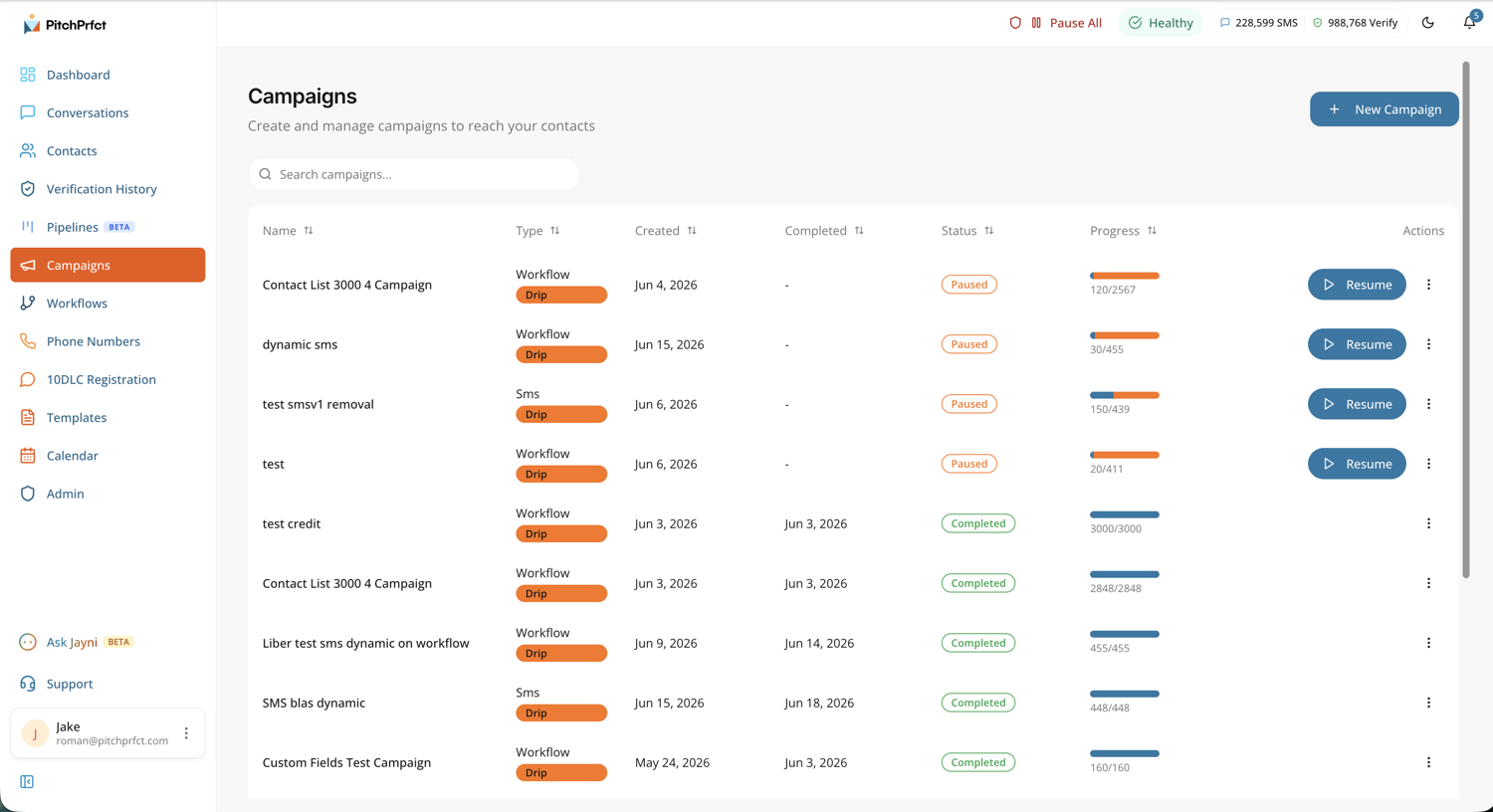
- Pick a compliant platform and register your 10DLC campaign (your provider should guide this).
- Build a clean, opted-in list. Import contacts who agreed to texts; scrub duplicates and invalid numbers.
- Segment if it helps. A relevant blast to 500 people beats a generic one to 5,000. Split by location, interest, or customer stage when it matters.
- Write one tight message. Identify yourself, deliver the value, give one clear call to action, and keep it near 160 characters. (Emojis force Unicode and can split your message into more — and more expensive — segments.)
- Personalize with merge fields — a first name lifts response.
- Send a test to yourself and a teammate first. Check links, the opt-out line, and how it renders.
- Schedule for the right moment — inside quiet hours, when your audience is likely to act.
- Be ready to reply. Route responses to a shared inbox so a human can take the conversation from there.
- Measure delivery, replies, clicks, and opt-outs — and tune the next one.
What makes a blast actually work
- One idea, one ask. Confused recipients don't act.
- Lead with the value, not your brand name.
- Create a reason to act now — a deadline, a limited quantity, an event time.
- Make the next step one tap — a single link or a simple reply keyword.
- Watch your timing and frequency. Over-texting is the top reason people opt out.
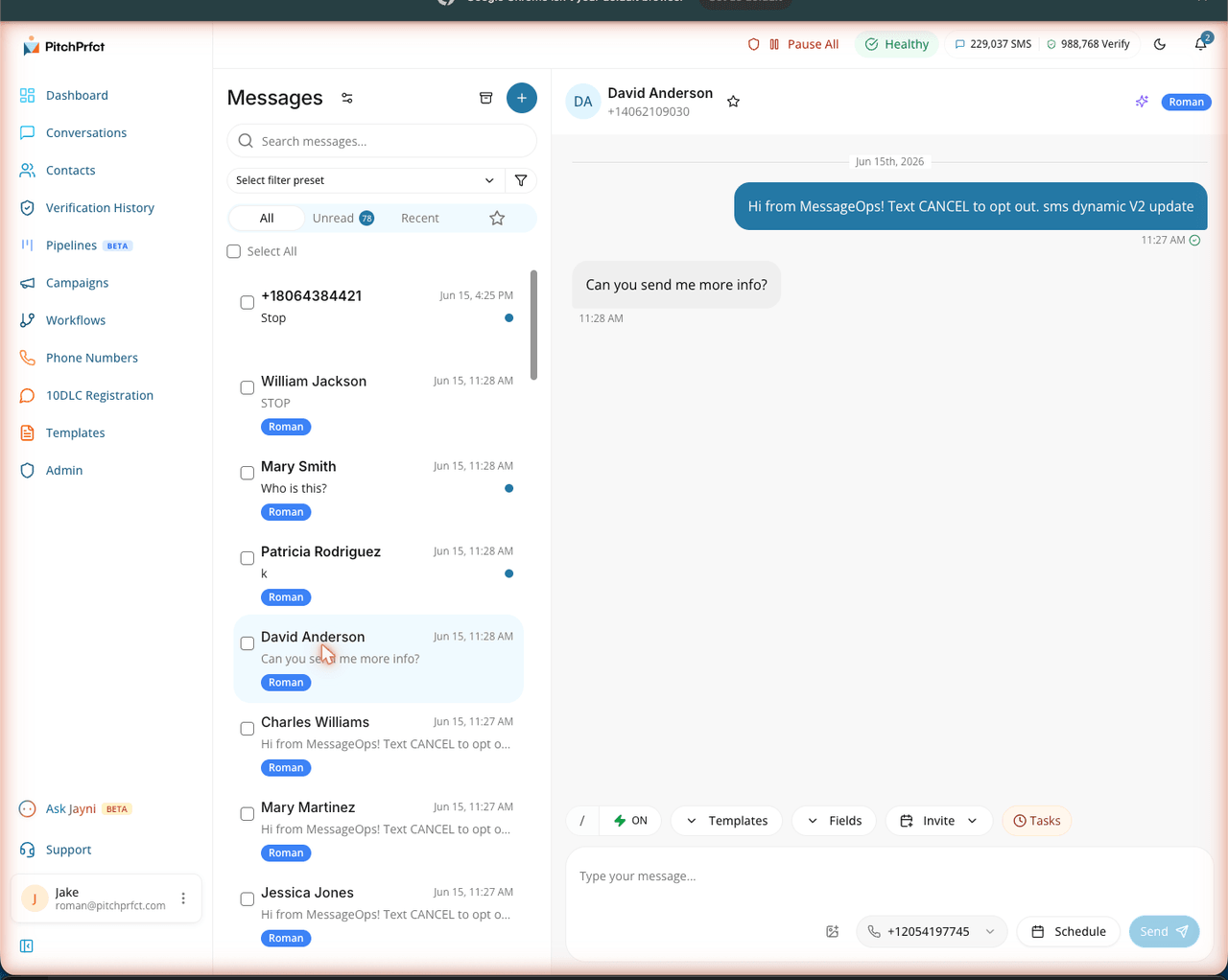
A blast doesn't end when it sends — it ends when you've worked the replies.
Speed up the writing with proven SMS templates you can drop in and personalize, and if you sell property, the patterns in our guide to real estate text message marketing map directly onto blast-then-follow-up. Sending from your desk? Here's how to text from your computer. For the bigger picture on the channel, start with what SMS marketing is.
Where PitchPrfct fits
If you're still choosing a tool, compare your options in our roundup of the best SMS marketing platforms, or go straight to the head-to-heads people ask about most: EZ Texting, Text-Em-All, and Text Request. Here's where PitchPrfct lands — built for sending real volume without the usual headaches:
- Built-in compliance: automatic opt-out handling, quiet-hours enforcement, and list scrubbing, plus guided 10DLC registration so your blasts deliver.
- Blast + two-way in one place: send to a whole list, then handle the replies in a shared conversations inbox — with workflows for automated follow-up.
- Flat, predictable pricing: $99/mo + $0.007 per segment, all-in (carrier fees included). Like any platform, $1/mo per number and the standard $10/mo TCR campaign fee apply on top — but no credit buckets and no per-message carrier surcharge, so a big blast doesn't trigger a surprise bill.
Frequently asked questions
What is an SMS blast?
How do I send a mass text blast?
How do I send an SMS blast the right way?
How much does an SMS blast cost?
Can people reply to an SMS blast?
Ready to send a blast that lands — and handle the replies? Start a free trial.