
A church text messaging service is the most reliable way to reach your congregation — most people read a text within minutes, while the bulletin insert and the mass email go unseen. This guide is for pastors, church admins, and volunteer coordinators who want to text members and volunteers well, and do it compliantly.
The numbers back it up. In 2026, 80% of churches use SMS to reach their congregation, and texts see roughly a 98% open rate with most read within three minutes (Pushpay, The Complete Church Texting Guide). No other channel comes close.
We build SMS software, so factor that in. But the playbook below works on any platform — the point is to use the channel your members actually check.
Why churches text
Email gets buried. Social posts reach a fraction of followers. A printed announcement reaches whoever's in the room that Sunday. Text is different: it lands in the one place people look all day, and it's read fast. For a ministry that runs on showing up — to a service, a small group, a serve day — that speed is the whole point.
If SMS is new to your team, our pillar on SMS marketing covers the fundamentals. Here we'll stay focused on church use cases.
What a church uses texting for
A few jobs cover most of what a church needs the channel to do.
Service and event reminders
A Saturday-night reminder lifts Sunday attendance. So does a heads-up before a midweek study, a youth night, or a special service. Send to the whole list or just the group that signed up.
Giving campaigns
Year-end giving, a building fund, a missions push — a short text with one clear link is how you remind people to give without another email no one opens. Time it to a sermon series or a deadline, and follow up once.
Prayer chains
When someone needs prayer now, the prayer team needs to know now. A text-based prayer chain reaches every volunteer in seconds instead of waiting on a phone tree. Members can opt into a prayer list and receive requests as they come in.
Volunteer coordination
Greeters, nursery, worship team, serve days — volunteers run on reminders. Text the schedule, fill a last-minute gap, and confirm who's showing up, all in one thread you can actually see.
Example church text scripts
Keep them short, name the church, give one ask, and use merge fields like
{{name}} so each text feels personal. Four to start:
Service reminder
Hi {{name}}, it's Grace Community Church. Reminder: Sunday service is 9 & 11am tomorrow. Hope to see you there! Reply STOP to opt out.
Event invite
{{name}}, our Family Game Night is this Friday at 6pm in the fellowship hall — free dinner, all ages welcome. RSVP here: [link]
Giving campaign
Hi {{name}}, our Building Fund is $4k from goal with 3 days left. Every gift counts — give here: [link]. Thank you for your generosity!
Volunteer scheduling
Hi {{name}}, you're on the greeter team this Sunday at the 9am service. Reply YES to confirm or LET US KNOW if you can't make it. Thank you!
For more patterns you can adapt, see our SMS templates.
The compliance part: yes, it applies to churches
This is the piece churches most often miss. Being a nonprofit or a faith organization does not exempt you from the rules.
- Members must opt in. Don't text a number just because it's in the directory. Get permission — a signup card, a website form, a "text JOIN to this number" keyword. Consent is the foundation of TCPA compliance, and it's the right thing to do.
- 10DLC registration still applies. To send any volume of texts that actually get delivered, U.S. carriers require you to register through the 10DLC framework — nonprofits and churches included. There's no faith exemption from carrier rules.
- Honor STOP instantly. Every message program must let people opt out, and that opt-out has to be honored automatically and permanently.
- Identify your church and respect quiet hours. Say who you are, and don't text late at night. A 10pm blast gets you reported as spam.
None of this should scare you off — it's routine, and a good platform handles most of it for you. It just means you can't skip the setup.
Where PitchPrfct fits
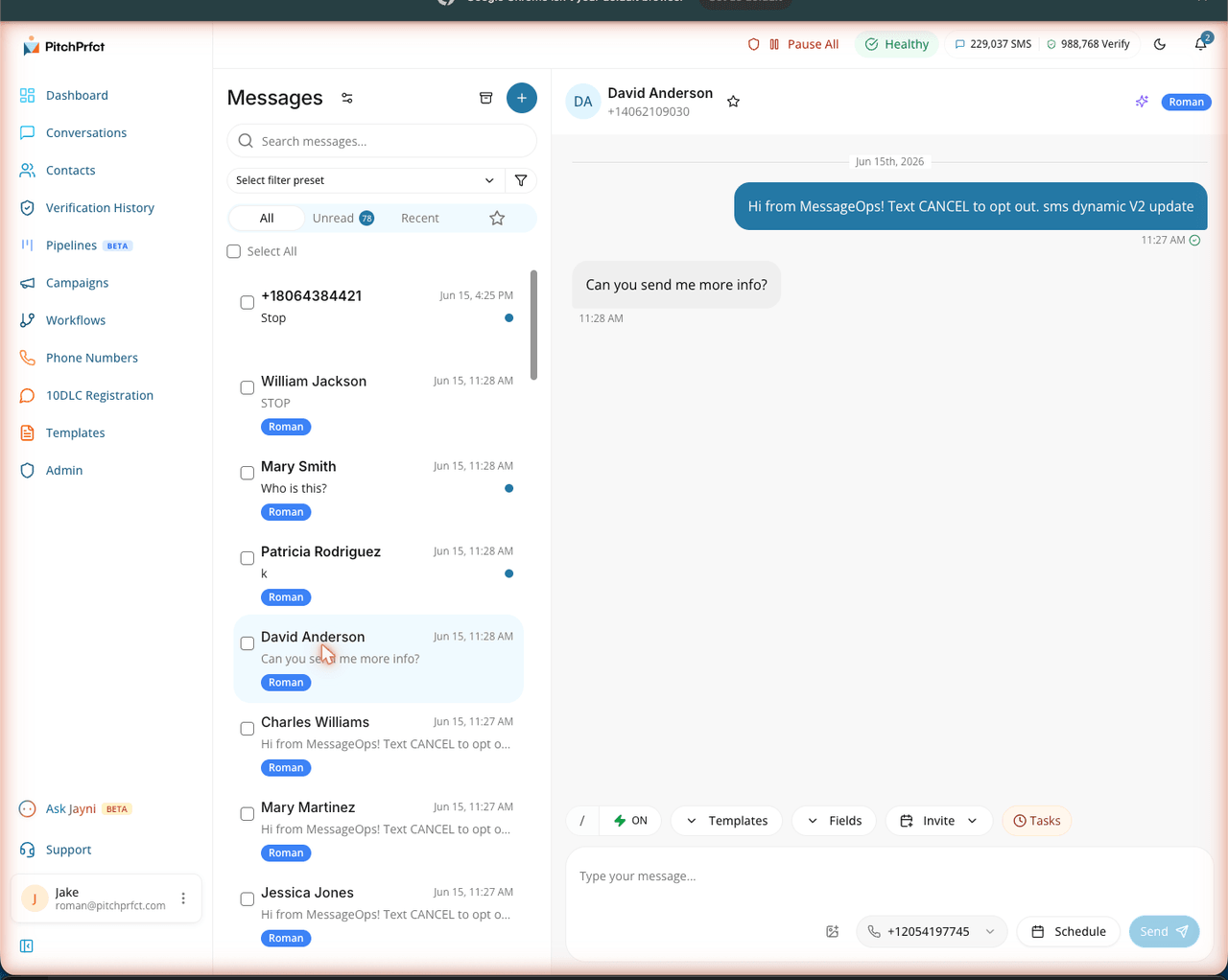
PitchPrfct is a compliance-first SMS platform for any organization that texts at scale — churches included. Here's the platform end to end:
What that means for a church:
- Built-in TCPA hygiene: automatic opt-out (STOP) handling, quiet-hours enforcement, and list scrubbing — handled by the platform, not a spreadsheet.
- Guided 10DLC registration so your admin isn't deciphering carrier rules alone.
- Flat, predictable pricing: $99/mo + $0.007 per segment, all-in (carrier passthrough included). Like any platform, $1/mo per number and the standard $10/mo TCR fee apply on top, and unused credits roll over one month. See pricing for the full breakdown.
- Two-way conversations and automated workflows for follow-up — a welcome text when someone joins the list, a reminder before an event, a thank-you after a gift — without a person pressing send each time.
- Jayni, our AI copilot, is live to help draft and manage messages.
It's SMS-only and connects to your other tools through Zapier, Make.com, and a REST API, so a new directory entry or event signup can trigger a text automatically.
For a single send to your whole list — a Sunday reminder or a giving push — an SMS blast goes out to everyone at once. The same compliance playbook carries over to other mission-driven groups; see our guide on SMS marketing for nonprofits.
Frequently asked questions
What is a church text messaging service?
Is mass texting for churches legal?
Do churches need 10DLC registration to send texts?
How much does church SMS cost?
How do members opt in to church texts?
Ready to reach your congregation where they actually look? Start a free trial.