
In recruiting, the first agency to reach a candidate usually wins them. A phone call goes to voicemail. An email sits unread for a day. A text gets read in minutes. That gap is why text recruiting has become the fastest way staffing and recruiting agencies fill roles — and why a placed candidate today started as a text someone answered before a competitor called. This guide is the playbook: speed-to-contact, scheduling, redeployment, and the consent rules that keep it legal. PitchPrfct builds SMS software, but what follows is the method, not the pitch.
One condition makes or breaks it: text recruiting only works when candidates opt in. Cold-texting a scraped resume list is not a strategy — it's a liability. Get consent right and the channel compounds.
Why texting wins for recruiters
Staffing runs on timing and volume, and texting fits both better than any other channel:
- Speed-to-contact. Candidates apply to several agencies at once. The one who replies first books the screen first. Texts get read in minutes; a voicemail often never gets heard.
- Reply rates email can't touch. Recruiter text outreach averages a 30–45% response rate, against roughly 3–15% for cold email (Ninjahire, 2026). Personalizing the message with the candidate's name and role lifts that another 30–40%.
- It scales high-volume hiring. Light-industrial, healthcare, hospitality, and seasonal ramps mean reaching hundreds of candidates fast. A segmented text to qualified, opted-in candidates does in minutes what a phone bank does in days.
- It revives your bench. Your best source of placements is the people you've already placed. A well-timed redeployment text ("new contract opening in your area — interested?") restarts conversations email lets go cold.
Compliance first — candidates have to opt in
This is the part that protects your number and your agency. SMS recruiting runs on real rules under the TCPA and carrier policy:
- Get explicit consent at the point of capture. Job-board apply flows, your career site, intake forms, QR codes at a hiring event — each should clearly state that the candidate agrees to receive texts. Document it (timestamp + source) and keep the record.
- Register your 10DLC campaign. Carriers filter unregistered business texting. Registration is what gets your messages delivered instead of silently dropped.
- Honor STOP immediately and suppress that candidate permanently.
- Respect quiet hours — roughly 8 a.m.–8 p.m. in the candidate's local time zone, and stricter where state laws apply.
One straight line for the high-volume crowd: texting works best with candidates who opted in to hear from you, not scraped resume lists or purchased contact files — there are rules to follow, and the FCC's texting rules spell out the specifics. The playbook below is for candidates who raised their hand: your applicants, your placed bench, and your re-engaged past contacts.
The four moments text recruiting owns
You don't text candidates about everything. You text them at the moments where speed and a reply actually move a placement forward.
1. Speed-to-contact on a new applicant
The instant a candidate applies, send a text. Not in an hour — now. An automated first text confirms you got the application and asks for a quick next step, buying a recruiter time to follow up personally while the candidate is still warm.
2. Interview and screen scheduling
Phone tag kills scheduling. A text with two time options and a one-tap confirm books the screen in one exchange. Reminders the day before and an hour before cut no-shows — the cheapest conversion win in staffing. See how this plays out in SMS appointment scheduling.
3. Onboarding and assignment logistics
Start date, address, what to bring, who to ask for. A short confirmation text the night before a first shift prevents the no-show that costs you the client's trust.
4. Redeployment of your bench
When a contract ends, the clock starts on placing that worker again. A redeploy text to your opted-in bench — "your assignment wraps Friday; I've got two openings nearby" — keeps good people working and keeps margin on your side.
Recruiting text messages that get replies
Compliance gets the message delivered. Craft gets the reply. The rules:
- Lead with who you are. Candidates apply to many agencies — never make them guess. ("Hi {{name}}, it's {{recruiter}} at {{agency}}.")
- One idea, one ask, under 160 characters. A wall of text reads like spam.
- Make the next step trivial. A time to confirm, a single link, a yes/no.
- Personalize with merge fields — name, the role they applied for, location.
Scripts you can adapt
- New-applicant speed-to-contact: "Hi {{name}}, it's {{recruiter}} at {{agency}} — thanks for applying to the {{role}} role. Got 10 min today to connect? Reply STOP to opt out."
- Interview scheduling: "Hi {{name}}, let's set up your screen for {{role}}. I have Tue 10am or Wed 2pm — reply 1 or 2 and I'll lock it in."
- Interview reminder: "Reminder: your {{agency}} interview is tomorrow at {{time}}. Reply C to confirm or R to reschedule."
- Redeployment / bench: "Hi {{name}}, your assignment wraps {{date}}. I've got a {{role}} opening near {{area}} starting soon — want the details?"
Put the timing on autopilot
Agencies that scale text recruiting use automation for timing and recruiters for conversation. The pattern is the same every time: a trigger fires a text, and the moment the candidate replies, a human picks it up.
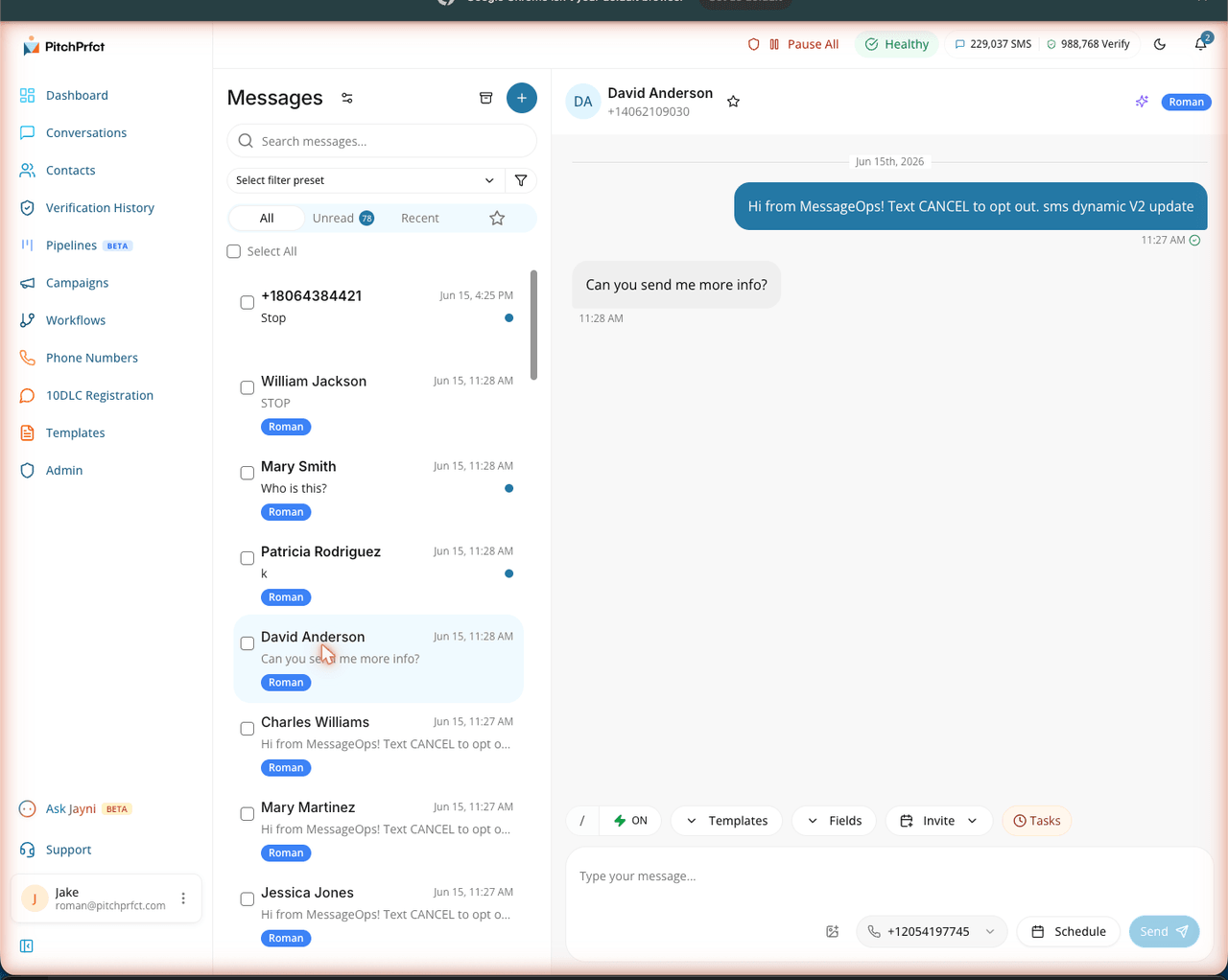
That mix is where SMS marketing stops being busywork and starts compounding. Build a small library of SMS templates for the moments that repeat — new applicant, interview confirm, reminder, redeployment — so any recruiter can fire the right message without rewriting it.
The workflow builder is where the reminders and bench nudges actually live: set the trigger, set the timing, and the texts send on their own.
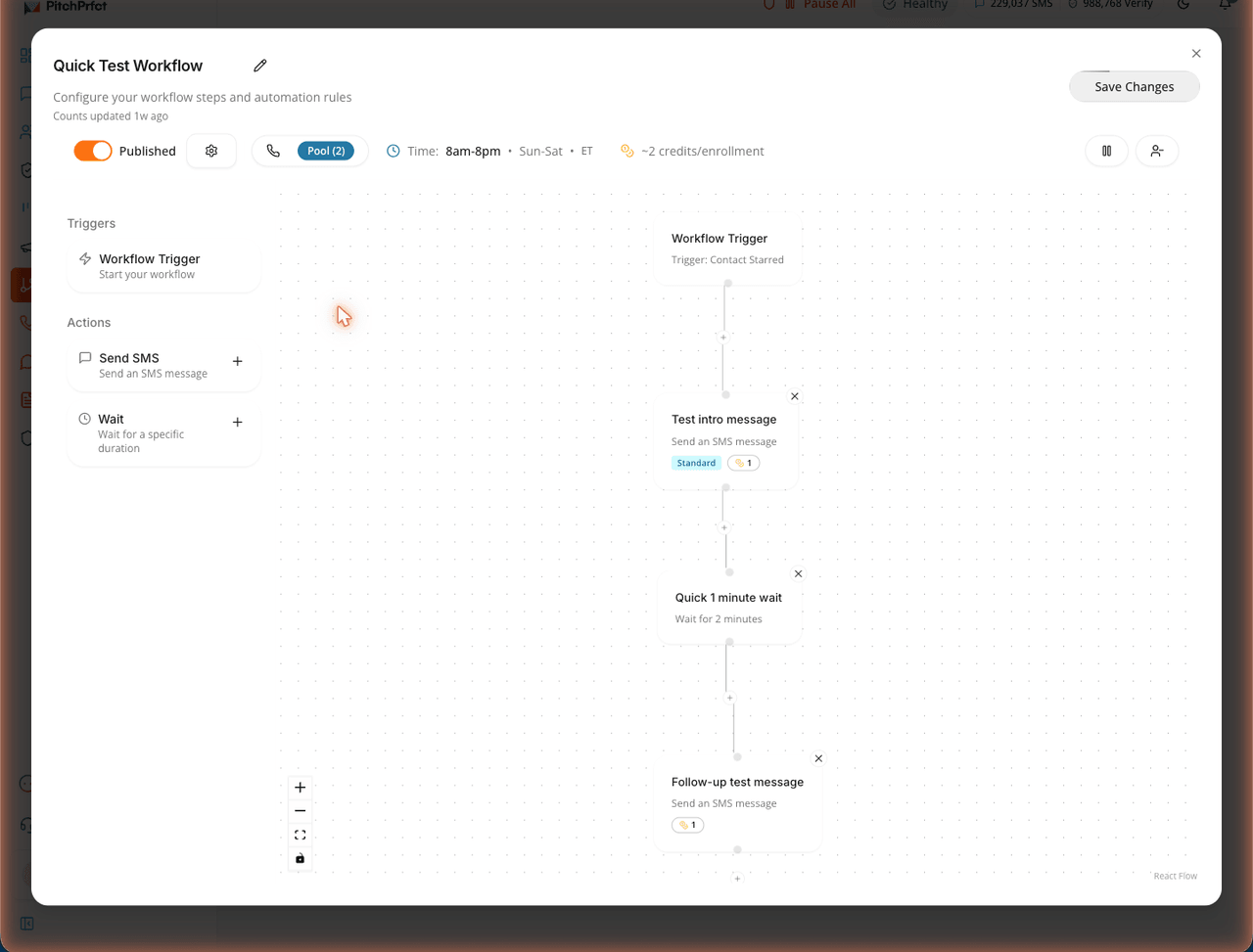
See the whole thing end to end:
Where PitchPrfct fits
PitchPrfct is a compliance-first SMS platform for any business that reaches people at scale — staffing and recruiting agencies included:
- Built-in compliance: automatic opt-out (STOP) handling, quiet-hours enforcement, and list scrubbing, plus guided 10DLC registration.
- Workflows + a conversations inbox for speed-to-contact, interview reminders, and redeployment — automated timing, human replies.
- Flat, predictable pricing: $99/mo + $0.007 per segment, all-in (carrier fees included). Like any platform, $1/mo per number and the standard $10/mo TCR campaign fee apply on top — no credit buckets, no per-message surcharge, and unused credits roll over a month. See the full pricing breakdown.
- Built to connect: Zapier, Make.com, a REST API, and webhooks sync your ATS so a new applicant or an ending assignment can trigger a text automatically. And Jayni, our AI assistant, is live.
It's SMS-only by design — not a full ATS or dialer — so if your day runs on cold calling or email sequencing, pair it accordingly. For texting your opted-in candidate pipeline, it's purpose-built. The same playbook works across verticals; see how it adapts for home services.
Frequently asked questions
Is text recruiting legal?
How fast should I text a new candidate?
What's a good response rate for recruiting text messages?
Do staffing agencies need 10DLC registration to text candidates?
Can I connect text recruiting to my ATS?
Want speed-to-contact recruiting with compliance handled for you? Start a free trial.