
In real estate, speed wins. The agent who answers a new lead in the first five minutes is the one who gets the appointment — and nothing answers faster than a text. Texts post a 98% open rate against roughly 10% for email, and a 45% response rate against 8–10% for email (Luxury Presence, citing Campaign Monitor and Tech Report, 2024). Ninety percent of texts are read within three minutes. SMS has quietly become the highest-converting channel agents have. Done right, it turns dormant lead lists into showings.
The hard part is "done right." Real estate texting sits on top of real compliance rules, and the difference between a system that converts and one that gets your number blocked is mostly setup. This is PitchPrfct's blog, so we build SMS software — but this guide is about the playbook, not the pitch.
Why texting works so well for agents
Real estate is a relationship business built on timing, and texting matches both:
- Speed to lead. A lead contacted within five minutes is 21× more likely to qualify than one contacted at 30 minutes (Harvard Business Review), and 78% of buyers work with the first agent who responds (National Association of Realtors). A text gets read in minutes; a voicemail often doesn't.
- Lower no-shows. Automated showing and appointment reminders measurably cut no-show rates — the single cheapest conversion win in the business.
- It meets clients where they are. Buyers and sellers already text their friends and family all day. A short, human text feels personal; a mass email feels like marketing.
- It revives cold lists. A well-timed, relevant text to an old lead ("still looking in Maple Grove?") restarts conversations email can't.
The rules of the road
Real estate texting works best with people who opted in, and there are a few rules worth following to protect your number and your reputation. The big ones come from the FCC's texting rules and the CTIA Messaging Principles; for the specifics that apply to you, our TCPA guide and 10DLC guide are a good starting point. As best practice:
- Get explicit consent at the point of capture. Website forms, QR codes on sign riders, open-house sign-ins, IDX registrations — each should clearly state that the contact agrees to receive texts. Document it (timestamp + source) and keep records for at least four years.
- Register your 10DLC campaign. Carriers filter unregistered business texting. Registration is how your messages actually get delivered.
- Honor STOP immediately and permanently suppress that contact.
- Respect quiet hours — roughly 8 a.m.–8 p.m. in the recipient's local time zone, and stricter where state "mini-TCPA" laws apply (Florida, Oklahoma, Washington, and a growing list).
One practical note for the investor/wholesaler crowd: texting works far better with people who opted in than with purchased or skip-traced homeowner lists — the playbook below is built around your leads, your past clients, and your sphere. We're not lawyers, so treat this as a starting point and check the current rules for your situation.
Build your list the right way
The strongest real estate texting lists come from people who raised their hand:
- Lead-gen forms (buyer/seller landing pages, home-valuation tools).
- Open-house sign-ins with an explicit text opt-in.
- Sign-rider keywords ("Text MAPLE to 555-123 for details") — high-intent and self-selecting.
- Past clients and sphere of influence, who already know you and convert best.
Segment from day one. A buyer in pre-approval, a seller weighing a listing, and a client three years post-close are three different conversations.
Texts that actually get replies
Compliance gets the message delivered; craft gets the reply. What works:
- Lead with who you are — recipients should never wonder. ("Hi Sam, it's Maria with Cedar Realty.")
- Keep it short and human — under 160 characters, one idea, one ask.
- Give value before the pitch — a new listing in their area, a price drop, a market stat for their street.
- One clear call to action — book a showing, reply with a time, tap one link.
- Personalize with merge fields — name, neighborhood, the property they viewed.
Scripts agents can adapt
- New lead (speed-to-lead): "Hi {{name}}, it's {{agent}} with {{brokerage}}. Saw you're interested in {{area}} — want me to send a few listings that match? Reply STOP to opt out."
- Open-house follow-up: "Thanks for stopping by {{address}} today, {{name}}! Any questions, or want to see something similar this week?"
- Showing reminder: "Reminder: we're touring {{address}} tomorrow at {{time}}. Reply C to confirm or R to reschedule."
- Seller lead: "Hi {{name}}, curious what your home in {{area}} could sell for right now? I can send a quick estimate — want it?"
- Past-client check-in: "Hi {{name}}, hard to believe it's been a year in the new place! If you (or anyone you know) is thinking of a move, I'm here."
Put it on autopilot (without losing the human touch)
The agents who scale texting use automation for timing and humans for conversation. A good platform lets you:
- Trigger sequences off events — new lead → instant text; showing booked → reminder 24 hours and 1 hour before.
- Drip nurture long-horizon leads (the buyer who's "6 months out") so they don't go cold.
- Route replies to a shared inbox so the moment someone responds, a real person takes over.
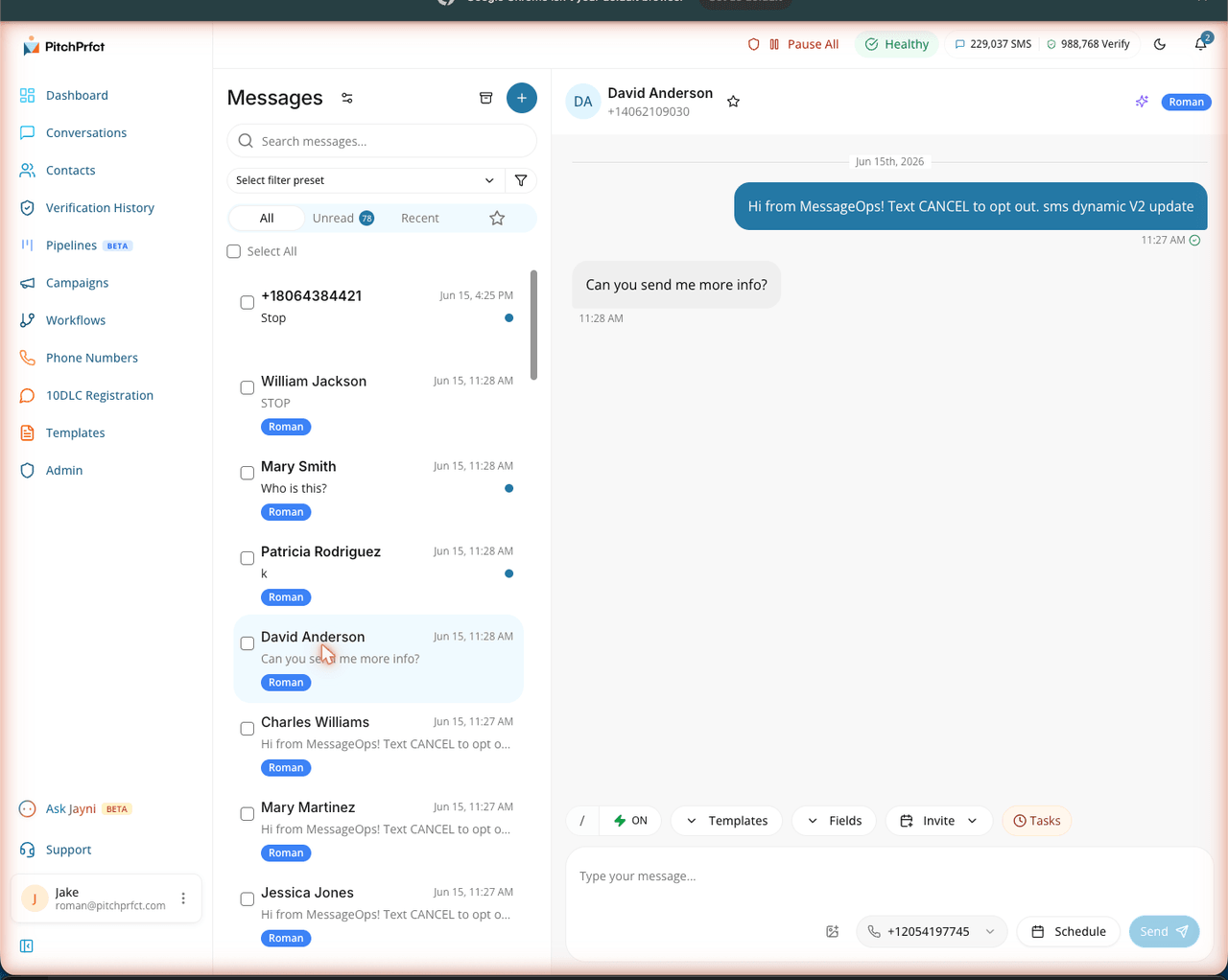
That mix is where SMS marketing stops being a chore and starts compounding. Build a small library of SMS templates for the moments that repeat — new lead, open-house follow-up, showing reminder — and a one-to-many SMS blast for the times you want to reach a whole segment at once, like a new listing or an open-house invite.
Where PitchPrfct fits
PitchPrfct is a compliance-first SMS platform built for any business that sells — real estate very much included:
- Built-in compliance: automatic opt-out (STOP) handling, quiet-hours enforcement, and list scrubbing, plus guided 10DLC registration.
- Workflows + a conversations inbox for speed-to-lead, showing reminders, and long-term nurture — automated timing, human replies.
- Flat, predictable pricing: $99/mo + $0.007 per segment, all-in (carrier fees included). Like any platform, $1/mo per number and the standard $10/mo TCR campaign fee apply on top — no credit buckets, no per-message carrier surcharge. See the full pricing breakdown.
- Built to connect: Zapier, a REST API, and webhooks wire your texting into the lead sources and CRM you already use. And Jayni, our AI assistant, is live.
The workflow builder is where the showing reminders and 6-month nurture drips actually live — set the trigger, set the timing, and the texts fire on their own.
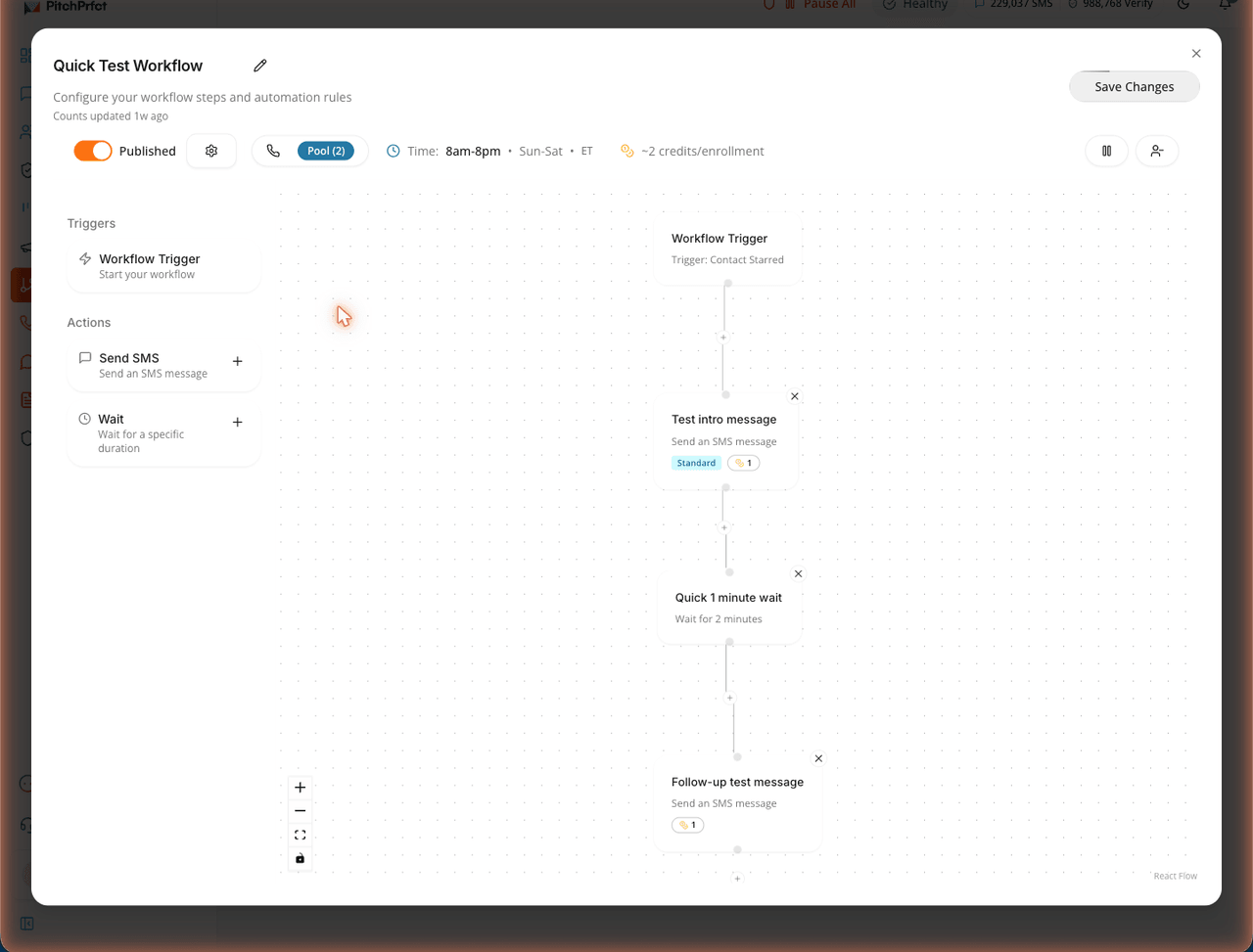
See the whole thing end to end:
It is SMS-first by design — not a full real-estate CRM or dialer — so if your day is built around cold calling, pair it accordingly. For texting your opted-in pipeline, it's purpose-built.
Frequently asked questions
Is text message marketing legal for real estate agents?
How fast should I respond to a new real estate lead by text?
What should a real estate text message say?
Do real estate agents need 10DLC registration to text clients?
What's the best tool for real estate text message marketing?
Want speed-to-lead texting with compliance handled for you? Start a free trial.