
Text messaging is the most-opened channel a campaign has — open rates run 95–98%, with most messages read within minutes (Subtext 2026 SMS Marketing Benchmarks). That reach is why political texting exploded: campaigns sent roughly 15 billion political texts in 2022 (NBC News), and Proofpoint clocked 2024 mobile political message volume at 3X the 2022 midterms. It's also one of the most-regulated channels, and in 2026 the practical bar is higher: major U.S. carriers now block effectively 100% of unregistered A2P traffic. Get the setup right and your messages land; get it wrong and they silently vanish.
If you're new to the channel, start with our pillar on SMS marketing, then come back here for the political-specific setup.
We build SMS software, not legal advice, so here's the practical picture a campaign actually needs to get texts delivered. Political texting comes with rules — consent, identification, opt-out, quiet hours, and carrier 10DLC/TCR registration with political verification — and we'll cover the gist and the setup. For the legal specifics, the authorities below are the source of truth: the FCC's texting rules, the CTIA Messaging Principles, and our own TCPA guide and 10DLC guide. To be clear, this is not legal advice — campaigns should confirm the current rules with counsel and the authorities above.
The short version
- Campaigns play by the same texting rules as everyone else. Being political doesn't change the consent and registration expectations for automated texting. Human-initiated peer-to-peer (P2P) texting has more room, but carrier rules still apply.
- Carriers expect registration. To send any volume, you register your organization as a brand with The Campaign Registry (TCR), complete political identity verification, and register a Political use case. Unregistered traffic gets blocked.
- The basics matter: clear sender identification, an easy opt-out, honoring STOP fast, keeping consent records, and texting only inside quiet-hours windows.
- P2P vs. A2P is the key fork. Smaller, human-sent volunteer texting and large automated broadcasts follow different setups and different throughput.
TCPA and political texting: the gist
A common assumption is that political messages get a free pass from the TCPA. The short version is that they don't get special treatment — the rules tend to turn on how a message is sent, not who is sending it:
- Automated/broadcast texting to mobile numbers generally follows the same consent expectations as any business, and the Do-Not-Call registry is part of the picture too.
- Peer-to-peer (P2P) texting — where a human presses send on each message, one conversation at a time — is handled differently because it isn't "automated" in the same sense. This is why volunteer phone-bank-style texting tools exist. P2P still has practical limits on speed and automation, and carrier rules apply to it either way.
In practice, the playbook is simple: get consent where you can, identify yourself, and make opt-out trivial. For where your specific program lands, lean on counsel and the FCC's texting rules rather than us — we build the software, not the rulings.
The part that trips everyone up: carrier registration (10DLC + TCR)
Compliance is one thing; delivery is another, and messages won't land unless they're registered. U.S. carriers route business and political texting through the 10DLC framework, governed by The Campaign Registry. For political senders there are extra steps:
- Register your brand. Your committee, PAC, party organization, or vendor registers as a brand with TCR (legal name, EIN, address, contacts).
- Complete political identity verification. Political brands must obtain a special authorization token through an identity-verification process before TCR will approve political traffic. This is the step most first-time campaigns miss — and it can take days, so start early.
- Register a "Political" use case. Categorizing the campaign correctly as Political is what unlocks the throughput political programs need. Miscategorized campaigns get throttled or rejected.
Skip any of these and carriers filter your messages — often with no error you'll notice until your reply rates crater. Build registration time into your calendar well before GOTV crunch.
Quiet hours, opt-outs, and identification
Three operational habits carry most of the practical risk, and the CTIA Messaging Principles are a good reference for the carrier side:
- Quiet hours. Stick to roughly 8 a.m.–9 p.m. in the recipient's local time zone (some states are stricter — see "mini-TCPA" laws below). A 10 p.m. blast is a fast way to get reported as spam.
- Opt-outs. Every message program should honor STOP immediately and automatically. Make opting out obvious; suppress that number permanently.
- Identification. Say who you are. Carrier expectations and good practice both point to clear sender identification — the committee or organization behind the message — typically in the first message and on request.
State "mini-TCPA" laws
Federal rules are the floor, not the ceiling. A growing list of states (Florida, Oklahoma, Washington, and others) have their own texting statutes — often called "mini-TCPAs" — with stricter consent rules and narrower calling windows. If you're texting voters across state lines, a safe rule of thumb is to follow the strictest window and consent standard that applies, not just the federal one. This is an evolving area, so check current state law for every state you contact.
What good political texting actually looks like
Compliance gets messages delivered; craft gets them to work. The campaigns that see real reply rates tend to:
- Lead with identity and purpose in the first line — who you are and why you're texting.
- Keep it short and human. One idea, one ask, one link. Walls of text read as spam.
- Segment by audience — volunteers, donors, persuasion targets, and GOTV reminders are different conversations.
- Make the ask singular and clear — RSVP, pledge to vote, find your polling place, donate — with a single link.
- Be ready to reply. Two-way texting beats one-way blasts; a real human response converts. Response rates on political SMS typically land in the 4–25% range depending on the ask (CampaignCNX), and replies are where persuasion and GOTV actually happen — so staff the inbox.
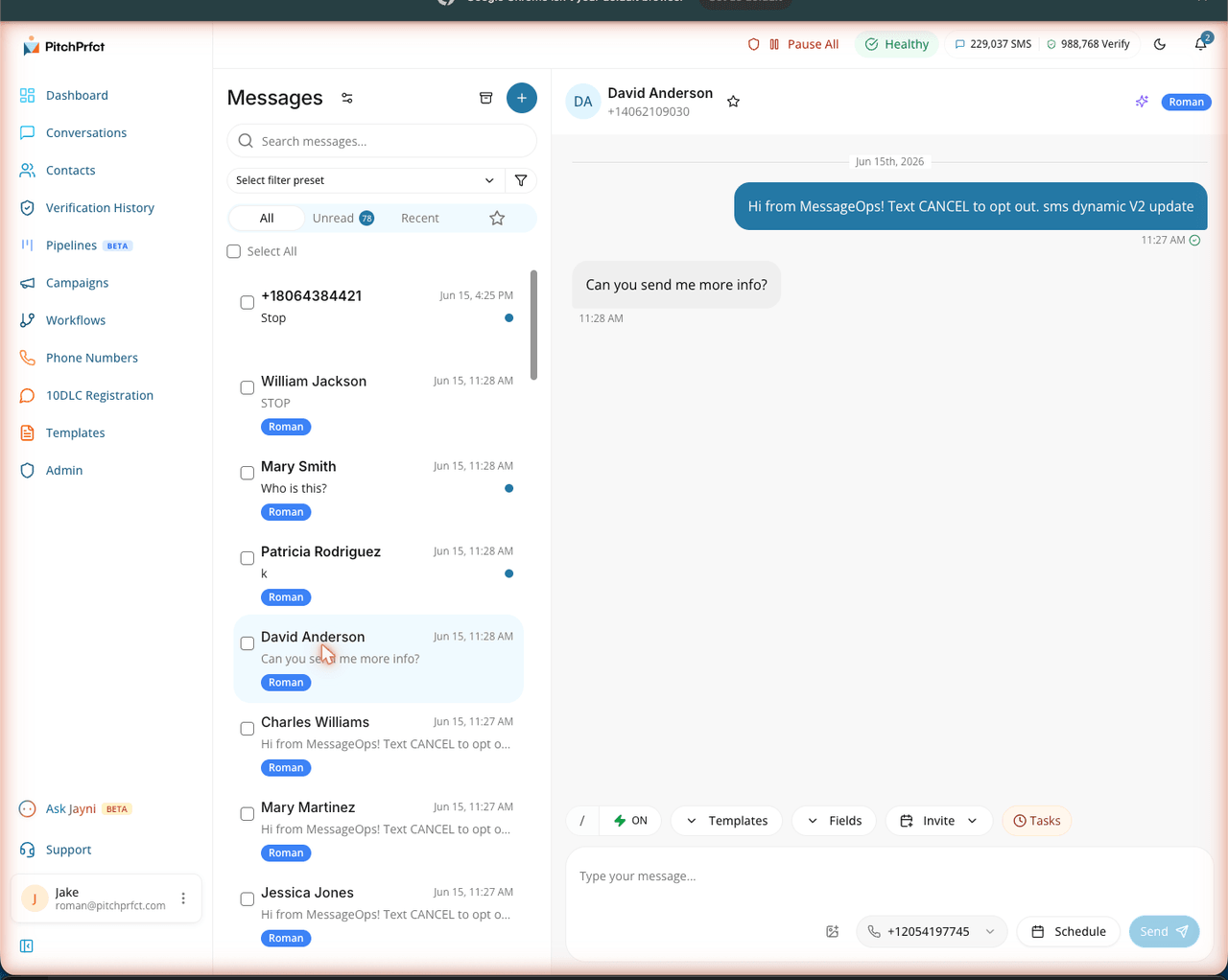
The same applies beyond campaigns: any door-knocking, follow-up-heavy outreach runs on two-way texting, which is why real estate text message marketing leans on the exact same playbook.
Where PitchPrfct fits
PitchPrfct is a compliance-first SMS platform built for any organization that needs to text at scale — campaigns included. Here's the platform end to end:
What that means in practice:
- Built-in TCPA hygiene: automatic opt-out (STOP) handling, quiet-hours enforcement, and list scrubbing — the operational rules above, handled by the platform instead of a spreadsheet.
- Guided 10DLC registration so you're not deciphering TCR alone.
- Flat, predictable pricing: $99/mo + $0.007 per segment, all-in (carrier passthrough included). Like any platform, $1/mo per number and the standard $10/mo TCR campaign fee apply on top — predictable for a campaign budget, with no credit buckets or per-message carrier surcharge. See pricing for the full breakdown.
- Two-way conversations, workflows, and a shared inbox for volunteer and staff follow-up, not just one-way blasts.
Automated sequences handle the repetitive work — a welcome text on opt-in, a reminder before an event, a thank-you after a pledge — without a human pressing send each time.
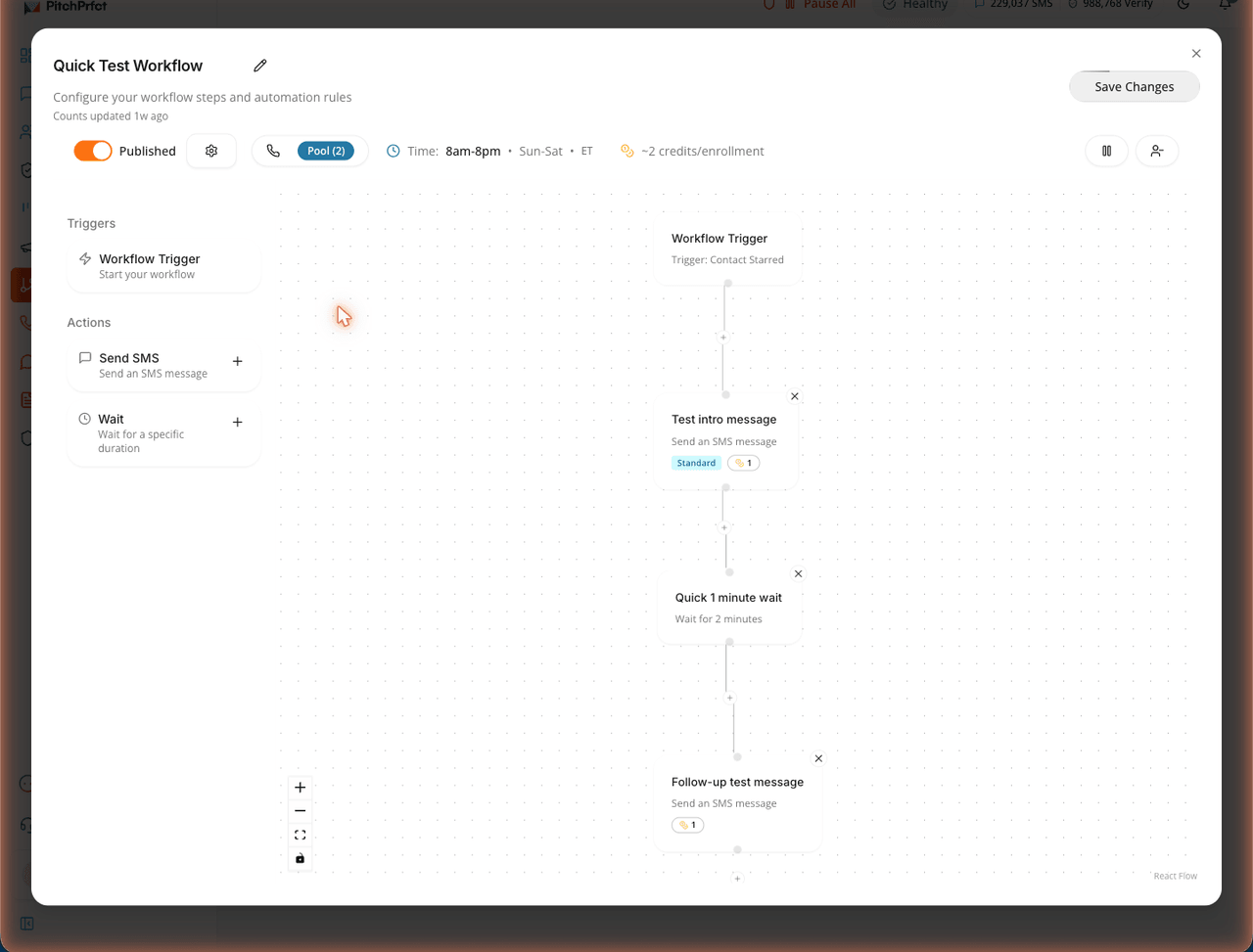
For a single broadcast — a GOTV reminder or an event RSVP to a registered list — an SMS blast sends to everyone at once; workflows then carry the conversation forward from each reply.
One thing to plan for: political brands complete TCR's political identity verification regardless of platform — it's a carrier step, not a vendor one. What a good platform does is make the rest (consent handling, quiet hours, opt-outs, delivery) automatic so your team can focus on the voters.
Frequently asked questions
Is political text messaging allowed?
Do political texts get a pass on the TCPA?
Do political campaigns need 10DLC registration?
What hours can political campaigns text?
What's the difference between P2P and A2P political texting?
Running campaign outreach and want compliance handled for you? Start a free trial.