
Your supporters already live on their phones. Email open rates keep sliding, and direct mail is slow and expensive. Text is where the attention is — and it's how small teams stay close to donors without a big budget. This guide covers how nonprofits use SMS marketing for donor outreach, fundraising campaigns, volunteer and event turnout, and recurring giving — all without crossing a compliance line.
Why texting works for nonprofits
A donor who ignores your newsletter will still glance at a text. That's the whole case. Texts get opened in minutes, replies feel personal, and the cost per message is tiny. For a lean nonprofit, that combination is rare: high attention, low spend, and a channel your supporters actually check.
It also fits how giving really happens. People give in moments — the end of a campaign, a matching-gift window, a disaster response. Email is too slow to catch those moments. A text lands while the moment is still open.
The numbers back it up. According to the M+R Benchmarks 2026 report, nonprofit advocacy text messages average a 2.6% response rate — far above what email typically returns — which is why texting has moved from a nice-to-have to a core channel for outreach and mobilization.
The use cases that move the needle
- Fundraising campaigns. A timed blast to your opted-in list during a match window or a year-end push, with a direct link to give.
- Recurring giving. Reminders, failed-payment nudges, and the occasional "your gift this month did X" update keep monthly donors from lapsing.
- Event and volunteer mobilization. Fill a volunteer shift, confirm a gala RSVP, or send day-of logistics — and cut no-shows with a reminder text.
- Thank-yous and stewardship. A fast, personal thank-you after a gift is one of the highest-ROI texts you can send. Retention starts the moment someone gives.
- Advocacy and action alerts. "Call your rep today" or "the comment period closes Friday" — time-sensitive asks that email can't deliver fast enough.
Most of these are just a well-timed SMS blast to a segment of your list. The rest are automated follow-ups.
How "text to donate" actually works
You can't collect a donation over raw SMS — carriers don't allow payment collection in the message stream. So "text to donate" really means one of two setups:
- Text-to-give links. You text supporters a short message with a link to your donation page or a payment link. They tap, give, done. This is the simple, flexible path and it works with any opted-in list.
- Carrier-billed giving (short codes). The classic "text GIVE to 12345 to donate $10 to your phone bill" model. It's recognizable but it runs on premium short codes through a registered partner, takes longer to set up, and caps the gift size. Most nonprofits today use giving links instead.
Either way, the texting platform sends the ask and the click; a payment tool (your donation page, Stripe, a giving platform) handles the money. PitchPrfct is the messaging layer — wire it to your giving page with a link, or connect your tools through the API and integrations.
Nonprofit text scripts that work
Keep them short, human, and personal. Identify your org, lead with the why, and end with one clear ask. Use merge fields so every text uses the supporter's name.
Campaign / match ask: "Hi {{name}}, it's {{org}}. A donor is matching every gift through midnight — give now and double your impact: {{link}}. Reply STOP to opt out."
Recurring-gift thank-you: "{{name}}, your monthly gift just funded {{impact}}. Thank you for showing up every month — it matters. — {{org}}"
Volunteer shift: "Hi {{name}}! We still need 3 volunteers for Saturday's {{event}} from 9–noon. Can you join us? Reply YES and we'll save you a spot."
Event reminder: "Reminder: {{event}} is tomorrow at {{time}}, {{location}}. We can't wait to see you, {{name}}! Questions? Just reply here."
The merge fields fill in automatically per contact, so a single campaign reaches thousands of donors and still reads one-to-one.
Staying compliant (donors must opt in)
This is the part too many orgs get wrong. Texting supporters isn't a free-for-all — it's consent-based.
- Get explicit opt-in. A donor giving you their number on a form is not the same as agreeing to marketing texts. Capture clear consent ("text me updates") and keep the record.
- Honor opt-outs instantly. Every message needs a working STOP. Once someone opts out, they're done — automatically.
- Respect quiet hours. No 6 a.m. or 11 p.m. asks. Stick to reasonable local hours.
- Register for 10DLC. Business and nonprofit texting on U.S. carriers requires 10DLC registration. It's what keeps your messages from being filtered out.
If the legal side feels heavy, here's the TCPA in plain English. PitchPrfct handles the mechanics for you: automatic STOP/opt-out handling, quiet-hours enforcement, list scrubbing, and guided 10DLC registration. You stay on mission; the compliance runs in the background.
Automating donor follow-up
The texts that build the most loyalty are the consistent ones — and consistency is exactly what a small team can't do by hand. That's where automation earns its keep. Set a trigger (a first gift, a lapsed monthly donor, a new volunteer signup), set the timing, and the right text fires on its own.
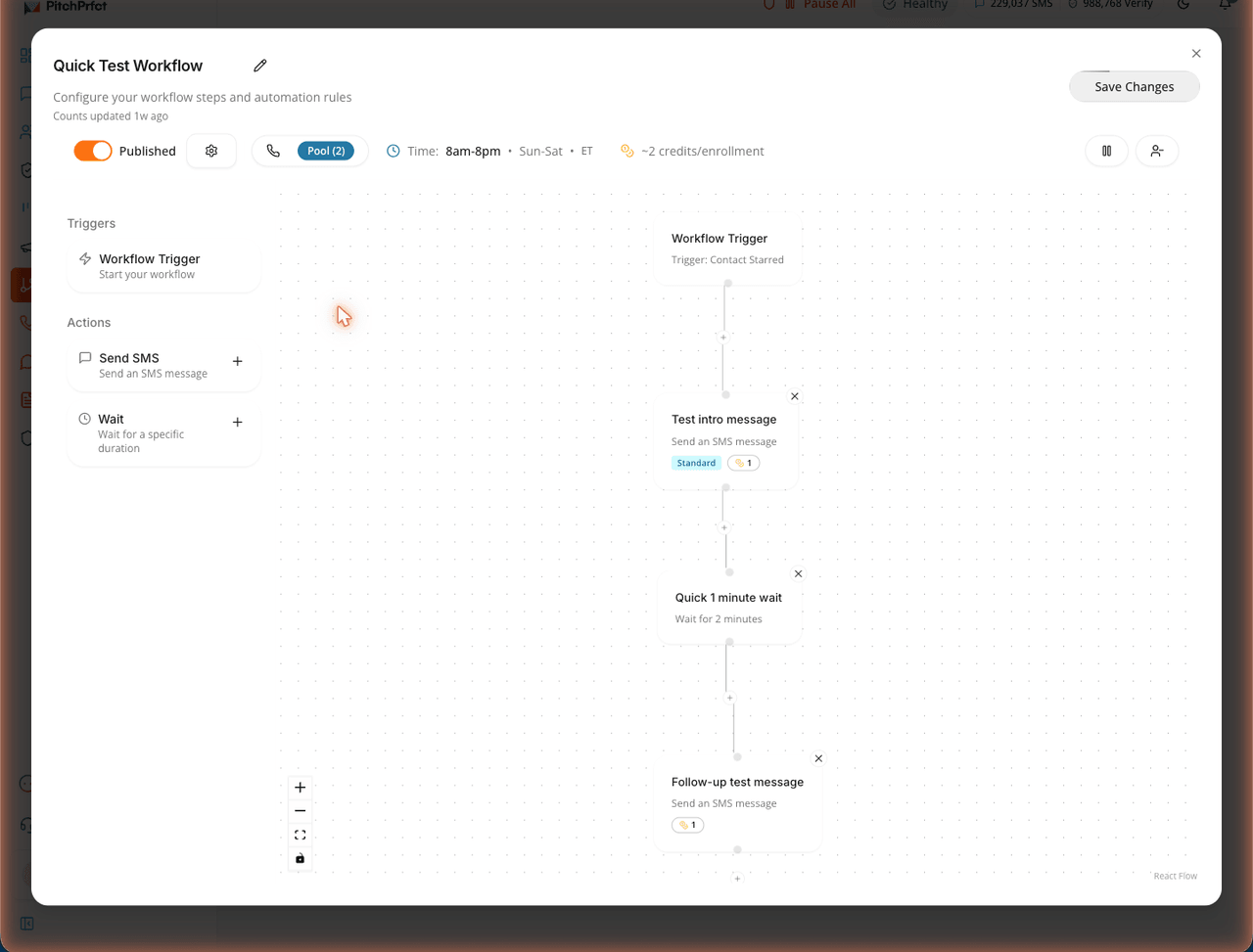
A simple, high-impact sequence: an instant thank-you when a gift comes in, a short impact update a week later, and a gentle re-engagement text if a recurring donor's payment fails. None of it needs a staffer watching the inbox.
Doing it on a budget
Nonprofit budgets are tight, so predictable pricing matters more here than almost anywhere. PitchPrfct is flat: $99/mo + $0.007 per segment, all-in — carrier fees included, billed per message, no credit buckets to burn through. ($1/mo per number and the standard $10/mo TCR campaign fee apply on top, like any platform; unused credits roll over one month.)
That means a year-end blast to 5,000 opted-in donors costs about $35 in messages on top of the flat monthly — predictable enough to put in a budget. See the full pricing breakdown.
PitchPrfct is SMS-first by design — not an email tool or a donor database — so pair it with your CRM and giving page. For texting your opted-in supporters, it's purpose-built: built-in compliance, a conversations inbox for real replies, workflows for the automated follow-ups, and Zapier, a REST API, and webhooks to connect the tools you already run. And Jayni, our AI assistant, is live.
If you run a faith community, the same playbook applies — see church text messaging for the congregation-specific version.
Frequently asked questions
Is text message marketing legal for nonprofits?
How does text to donate work for a nonprofit?
Do donors have to opt in before we can text them?
How much does SMS marketing cost for a nonprofit?
What's the best way to use SMS for nonprofit fundraising?
Want donor texting with compliance handled for you? Start a free trial.