
A web lead fills out a form at 9 p.m. asking about a used Tahoe. If a salesperson calls at 10 the next morning, the lead has already pinged three other dealers. SMS marketing for car dealerships closes that gap. A text reaches the shopper in seconds, gets read in minutes, and starts the conversation while they still care. The same channel that books a test drive also books the oil change, recovers the no-show, and asks for the five-star review. This guide walks the real use cases, with scripts you can lift.
This is PitchPrfct's blog, so we build SMS software. The playbook below works on any platform — it's about selling cars and filling service bays, not the pitch.
Why texting fits a dealership
Car shoppers live on their phones, and they ignore voicemail. A call from an unknown number goes unanswered; a text gets opened. Two reasons it works better than anything else in a dealership:
- Speed on hot leads. A lead that filled out a form is shopping right now. The MIT / InsideSales Lead Response Management Study found that reaching a web lead inside five minutes makes them roughly 21x more likely to qualify than a 30-minute wait. A text is the fastest tool you have to land in that window — faster to send than a call, and far more likely to get answered.
- Service-bay revenue. Most of a dealership's profit hides in fixed ops, not the front lot. A reminder when a car is due, a quick approval text for recommended work, a "your vehicle is ready" message — that's repeat revenue that books itself. Appointment reminders by text are a well-documented way to cut no-shows, which is the cheapest service customer you'll ever recover.
One channel covers both the sale and the years of service after it. That's why dealerships text.
Compliance first — shoppers opt in
Texting a customer is regulated, and getting it right is what keeps your numbers sending. Lead with consent and the rest follows. A few ground rules before your first send:
- Get explicit opt-in. A checkbox on the web lead form, a "Text US to 55-555 for inventory updates" keyword on the lot, a consent line when a service customer hands over their number. The shopper agrees to texts and knows what they signed up for.
- Register your 10DLC campaign. Carriers filter unregistered business texting. Registration is what gets your follow-up delivered instead of dropped.
- Honor STOP instantly and suppress that number.
- Respect quiet hours — roughly 8 a.m. to 8 p.m. in the customer's local time, stricter where state rules apply. Nobody wants a finance offer at 6 a.m.
For solid opt-in language, see our SMS opt-in examples. For the details of the law, our TCPA guide and the FCC's texting rules cover it. This isn't legal advice — it's the practical version. Every script below is for shoppers and customers who opted in.
The seven texts that sell and service
Here's the full menu, with where each one fits in the customer's life with the dealership.
| Use case | When it fires | What it does |
|---|---|---|
| New-lead / test-drive follow-up | Minutes after a form fill or showroom visit | Beats other dealers to the first reply, books the drive |
| Trade-in & finance offers | Equity window, lease maturity, payoff date | Pulls past buyers back in with a real reason |
| Service & maintenance reminders | Mileage or time interval | Books fixed-ops revenue that schedules itself |
| Recall notices | When a campaign hits the VIN | Gets the car in safely, builds trust |
| Sales-to-service handoff | First service due after delivery | Turns a buyer into a service customer |
| Review requests | Day after delivery or service | Builds the reputation that sells the next car |
| Win-backs | Lapsed lead or lapsed service customer | Re-opens a conversation that went cold |
1. New-lead and test-drive follow-up
The hot-lead text is the one that pays for the whole program. A shopper submits a form or walks the lot; within minutes, a text goes out. Short, personal, one clear next step.
- "Hi {firstName}, it's Maria at Westside Auto. Saw you're interested in the 2023 RAV4 — it's still here. Want me to hold it for a test drive this evening?"
The reply rate on a text sent in the first five minutes is in a different league from a callback the next morning. This is where automation earns its keep: the moment a lead lands, the first text fires, even at 9 p.m.
2. Trade-in and finance offers
Your past buyers are your best inventory source and your easiest next sale. Segment by equity, lease maturity, or payoff date, then reach out with a real reason — not a generic blast.
- "Hi {firstName}, your {vehicle} has strong trade value right now and we're short on used inventory. Want a quick number? No obligation — just reply YES and I'll run it."
Lease maturity and finance offers work the same way: a time-boxed, relevant message to a specific segment beats a price-bomb to your whole list every time.
3. Service and maintenance reminders
This is the quiet revenue engine. Trigger a reminder off mileage or a time interval and the bay fills itself.
- "Hi {firstName}, your {vehicle} is due for its 30k service. We've got openings this week — reply with a day that works and we'll get you in."
A confirmation when the appointment is booked, a reminder the day before, and a quick approval text for recommended work keep the schedule full and the no-shows down. For the booking flow end to end, see SMS appointment scheduling.
4. Recall notices
A recall text gets the car in safely and builds real trust — you're looking out for the customer, not selling them. Keep it plain and clear.
- "Hi {firstName}, there's an open safety recall on your {vehicle}. The repair is free and quick. Reply and we'll schedule it at your convenience."
5. Sales-to-service handoff
Most buyers never come back for service, and that's lost revenue for the life of the car. A text at the first service interval bridges the gap.
- "Hi {firstName}, hope the {vehicle} is treating you well! You're coming up on your first service — want us to set a reminder and get you on the schedule?"
6. Review requests
Reputation sells cars. A text the day after delivery or a service visit, while the experience is fresh, lands far better than an email a week later.
- "Thanks for your business, {firstName}! If you've got 30 seconds, a quick review really helps our team: {link}. We appreciate you."
7. Win-backs
Leads go cold and service customers drift. A light, well-timed win-back re-opens the door without being pushy.
- "Hi {firstName}, it's been a while! We've got fresh inventory and some strong trade numbers right now. Want me to send a few options that fit what you were after?"
Put the timing on autopilot
A dealership has too many moving parts to send these by hand. The point of automation is that the right text fires without anyone remembering:
- Trigger off events — lead lands → instant follow-up; appointment booked → confirmation; day-before → reminder.
- Trigger off tags — tag a contact "trade-in candidate" and a sequence starts; tag "no-show" and a recovery text goes out.
- Keep replies human — when a shopper texts back with a question, a real salesperson picks it up in the inbox.
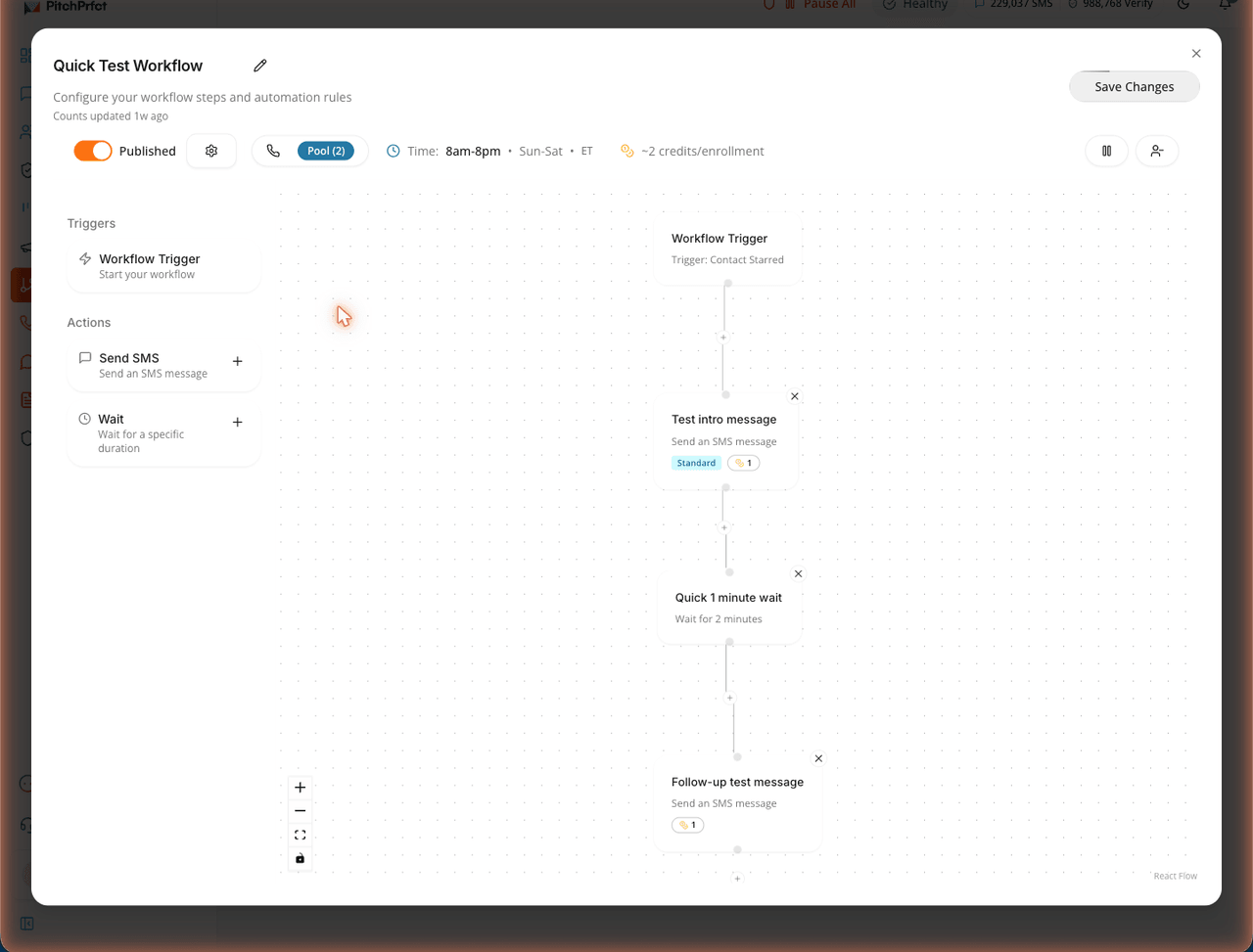
That mix — automation for timing, humans for the conversation — is where SMS marketing stops being a chore and starts compounding deals.
Where the conversation lives
Every reply lands in one inbox, so a lead's text doesn't get lost between a salesperson's cell phone and the CRM. Filter to unread, tag by where the shopper is in the buying process, and the next follow-up is one click away.
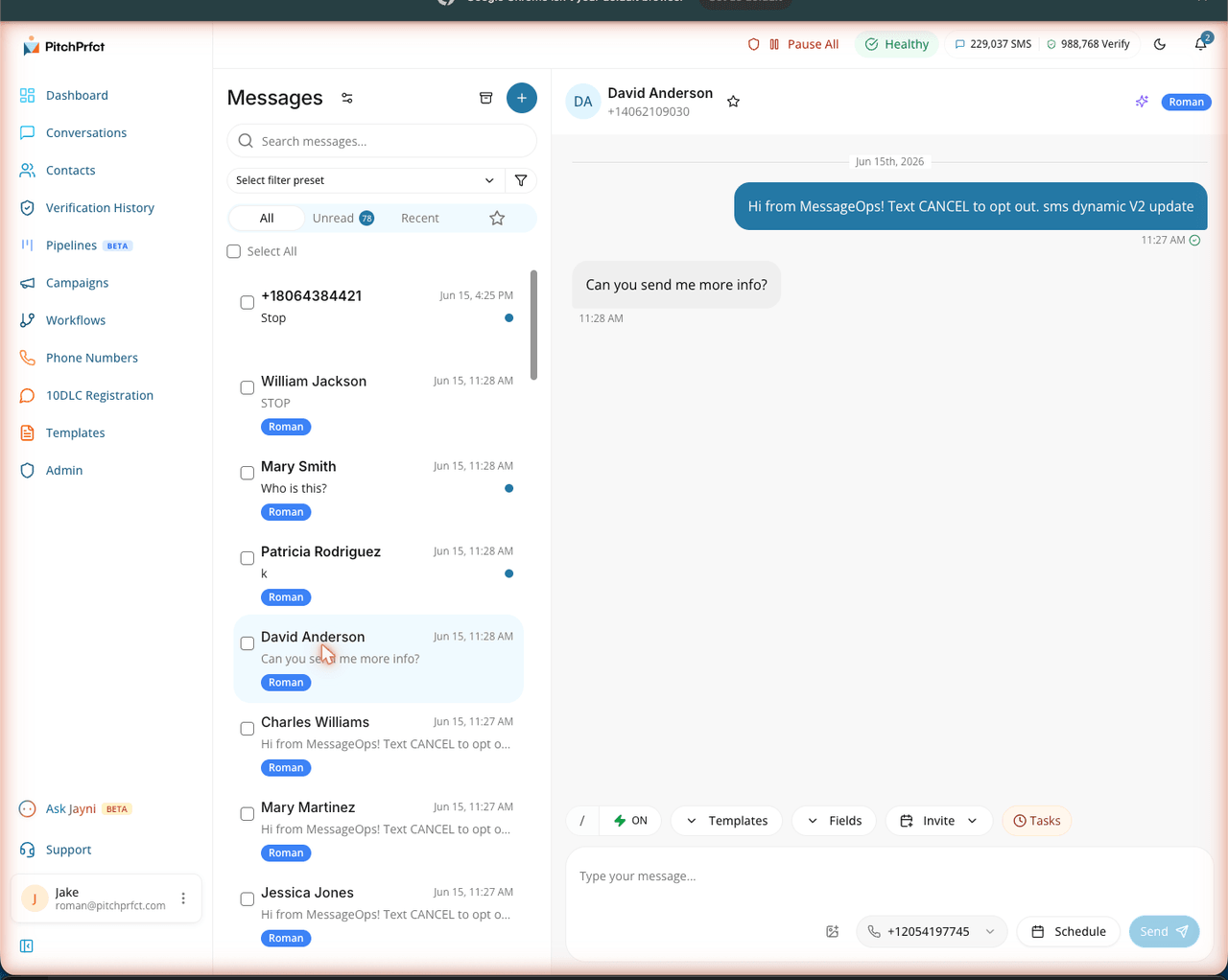
See the whole thing end to end:
Where PitchPrfct fits
PitchPrfct is a compliance-first SMS platform built for any business that sells — dealerships included:
- Built-in compliance: automatic opt-out (STOP) handling, quiet-hours enforcement, and list scrubbing, plus guided 10DLC registration.
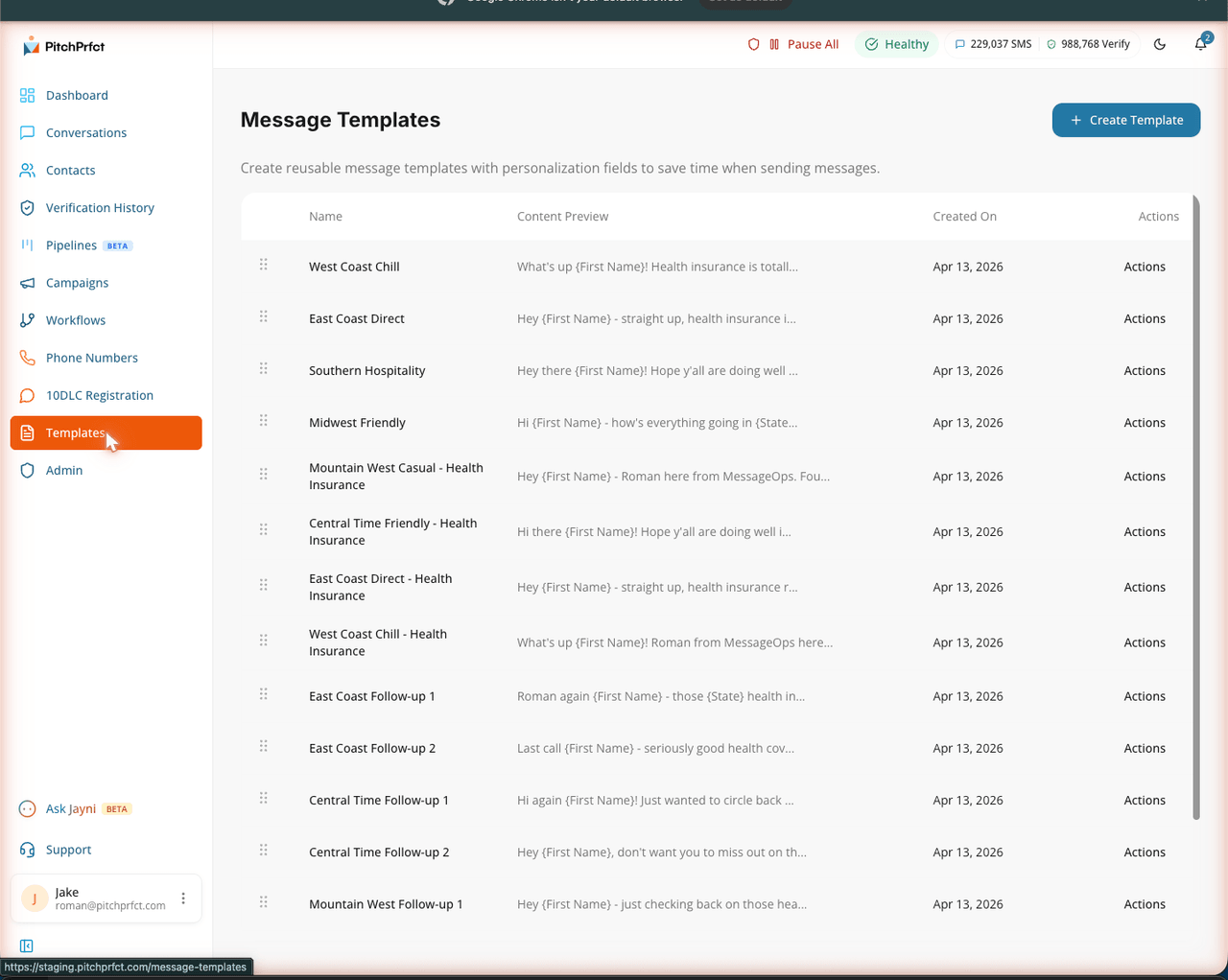
- Campaigns, templates, workflows, and a conversations inbox for hot-lead follow-up, service reminders, and the back-and-forth when a shopper replies.
- Flat, predictable pricing: $99/mo + $0.007 per segment, all-in (carrier fees included), charged per message — no credit buckets, no per-message surcharge. Like any platform, $1/mo per number and the standard $10/mo TCR campaign fee apply on top. See the full pricing breakdown.
- Built to connect: Zapier, Make.com, a REST API, and webhooks wire your texting into the CRM and DMS you already run. And Jayni, our AI assistant, is live.
It's SMS-first by design — it sits alongside your CRM and handles the texting. For fast follow-up on hot leads and a service bay that books itself, it's purpose-built.
Related reading
Texting other parts of your business too? See our guides on SMS marketing for home services and real estate text message marketing — the playbooks rhyme. New to the channel? Start with what is SMS marketing.
Frequently asked questions
Is SMS marketing legal for car dealerships?
How fast should a dealership respond to a web lead?
What should a car dealership text message say?
How do dealerships use SMS for service?
How much does dealership SMS marketing cost?
Want faster lead follow-up and a fuller service bay, with the compliance handled for you? Start a free trial.