
A group text is one shared thread. Everyone on it sees everyone else's number, and every reply goes to the whole group. A mass text — also called a broadcast — sends a separate, private message to each person. Recipients can't see each other, replies come straight back to you, and each text can be personalized with the person's name. Same idea on the surface, very different in practice. Here's which one you actually want.
Group text vs mass text at a glance
| Group text | Mass text / broadcast | |
|---|---|---|
| Who sees whom | Everyone sees every number | Each person sees only your number |
| Replies | Go to the whole group | Come straight to you, 1:1 |
| Personalization | One message for all | Merge each name, Hi {firstName} |
| Size limit | ~32 on iMessage, ~10–20 on carrier MMS | Hundreds or thousands |
| Opt-out | None — people are stuck | Built-in STOP/unsubscribe |
| Compliance | Not built for business | 10DLC-registered, consent-based |
| Best for | A few friends or coworkers coordinating | Any business texting a list |
The short version: a group text is a conversation. A mass text is a campaign.
What is a group text?
A group text is the thread you start when you tap a few people into one message on your phone. Everybody lands in the same conversation. When one person answers, the answer pings all of them. It works the way a group dinner plan should: nine people, one thread, everyone in the loop.
That shared-thread design is the whole point for personal use. It's also exactly what makes it wrong for business. Every recipient sees every other phone number. Reply once and you've just texted twenty strangers. There's no way for someone to leave quietly — they either mute the thread or ask the whole group to take them off it.
Group texts also hit a hard ceiling fast. On iPhone, an iMessage group maxes out around 32 people. The moment one Android phone joins, the thread drops to carrier MMS, where the limit falls to roughly 10 to 20 depending on the carrier. Try to add more and the message just fails to send. So "group text the whole customer list" was never really on the table — the phone won't let you.
What is a mass text?
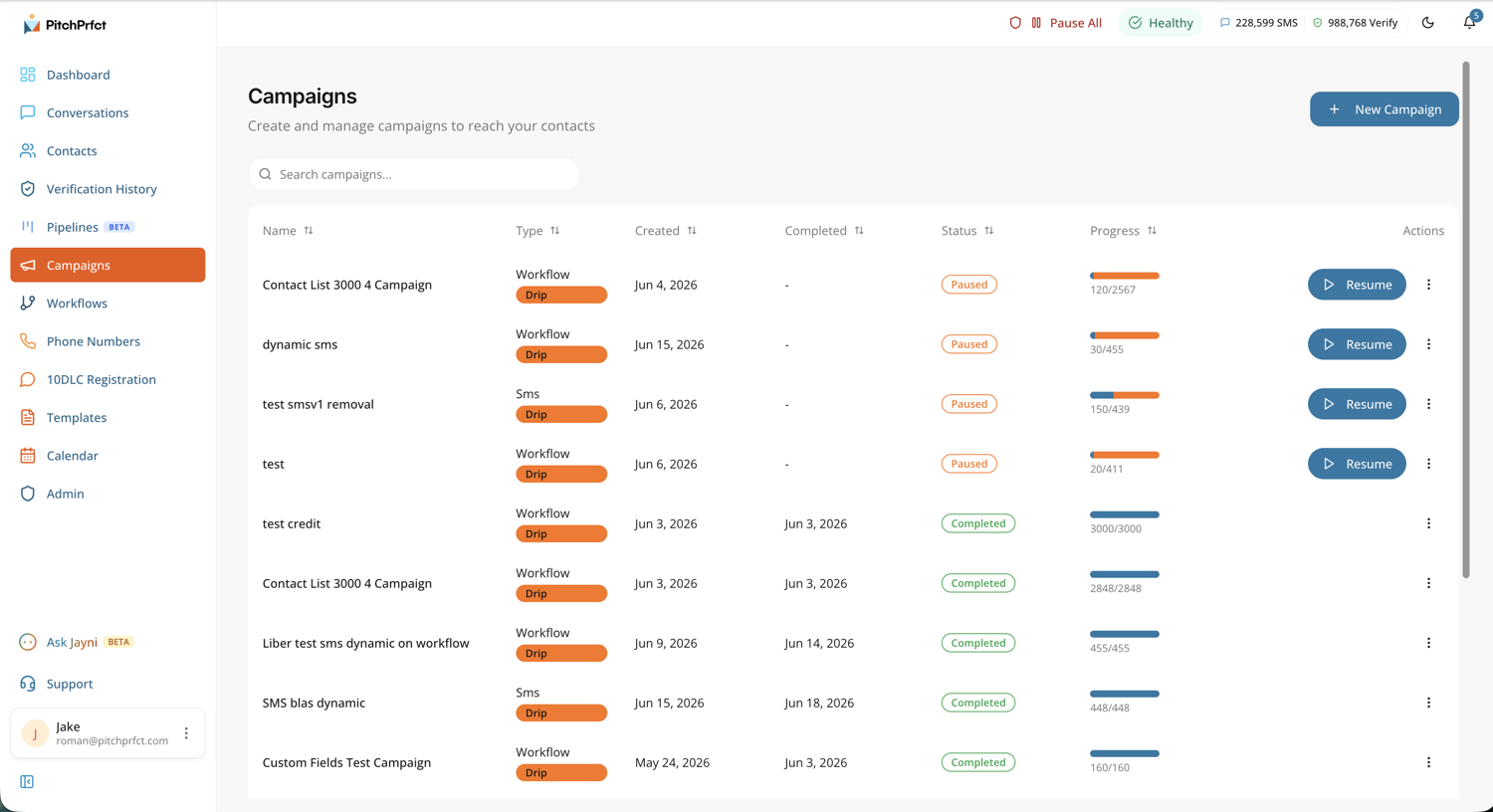
A mass text sends one message to a whole list, but each person receives it as an individual, private text. They see your business number and nothing else. No other recipients, no shared thread. When they reply, it comes back to you alone — a normal one-to-one conversation, not a free-for-all.
This is also called a broadcast, and it's how every legitimate business texting tool works. A mass text platform adds the parts a phone can't: list import, send scheduling, per-message personalization, opt-out handling, and the carrier registration that lets you send real volume in the first place. You're not blasting from your cell. You're sending from a registered business number built for it.
The personalization is the part people underrate. Because each text is its own message, you can drop in merge fields — Hi {firstName}, your order shipped — and every recipient gets a text that reads like you wrote it just for them. A group text can't do that. One message, sent to everyone, name and all.
The reply-all problem (why group texts break at scale)
Picture a group text to 40 customers about a weekend sale. Within minutes, one replies "Take me off this." Everyone sees it. Two more pile on. Someone hits reply with a thumbs-up, and now 40 phones are buzzing over a thumbs-up. You've turned a promotion into a public argument, and you've handed every customer the phone number of every other customer.
That's not a worst case. It's the normal case. A shared thread means a shared mailbox: every reply, reaction, and "who is this?" lands on every screen. For two friends planning a trip, that's the feature. For a business reaching a list, it's a privacy leak and a support headache rolled into one.
A broadcast removes the problem by design. Each message is its own private thread. A reply reaches you, not the crowd. One person opting out doesn't spam anyone else. The conversation stays where it belongs — between you and one customer.
Why business outreach needs a broadcast
Once you're texting more than a small group, the requirements change. A broadcast platform exists to meet them.
Personalization. Merge fields turn a blast into something that reads one-to-one. Hi {firstName} beats "Hi everyone" every time, and you can pull in any field you've stored — appointment time, agent name, order number.
Opt-out handling. US texting rules require an easy way out. A broadcast tool watches for STOP and unsubscribe keywords and removes people automatically, so you stay compliant without thinking about it. A group text has no such thing — there's no clean exit at all.
10DLC registration. Sending business texts to US numbers at volume runs through 10DLC, the carrier registration that tells networks your traffic is legitimate. Registered traffic on a dedicated business number is what keeps your messages flowing. A personal phone firing identical texts to a big list gets flagged as spam and throttled — that's the system working as intended.
Deliverability. Consent-based sending to people who opted in is what earns the inbox. The FCC and the CTIA Messaging Principles set the ground rules; this isn't legal advice, but consent-first sending is the practical foundation for both deliverability and trust. A registered broadcast respects all of it. A group text was never built to.
If you want the deeper background on consent and registration, our guides on TCPA compliance and what 10DLC is cover the specifics.
When to use each
This part is simple. For personal coordination, a group text is fine. You don't need a platform to plan a birthday dinner.
Use a group text when:
- You're coordinating with a small group — a few friends, your project team, a handful of coworkers.
- Everyone should see each other's replies — they're all part of the same plan.
- The group is small enough to stay under the carrier cap (well under ~10–20 if any Android phones are in it).
- Nobody minds that their number is visible to the rest of the group.
Use a mass text / broadcast when:
- You're texting customers, leads, members, volunteers, or staff — any real list.
- Recipients shouldn't see each other's numbers (which, for a business, is almost always).
- You want replies to come to you privately, not to the whole group.
- You need personalization, scheduling, opt-out handling, or 10DLC compliance.
- The list is bigger than a phone's group cap — or might grow past it.
A real estate agent texting 200 past clients about a new listing? Broadcast. A church reminding the worship team about Sunday call time? Group text is fine — it's eight people who all know each other. A recruiter following up with 50 candidates? Broadcast, personalized by name. A wholesaler blasting a price drop to a buyer list? Broadcast. The test is easy: if it's a few people who'd benefit from seeing each other, group text; if it's a list you're reaching as a business, broadcast.
How PitchPrfct handles broadcasts
PitchPrfct is built for the broadcast side. You import a list (or pull a saved segment), write your message, drop in merge fields like {firstName}, and schedule the send. Every recipient gets a private, individual text from your registered business number — no shared thread, no exposed numbers.
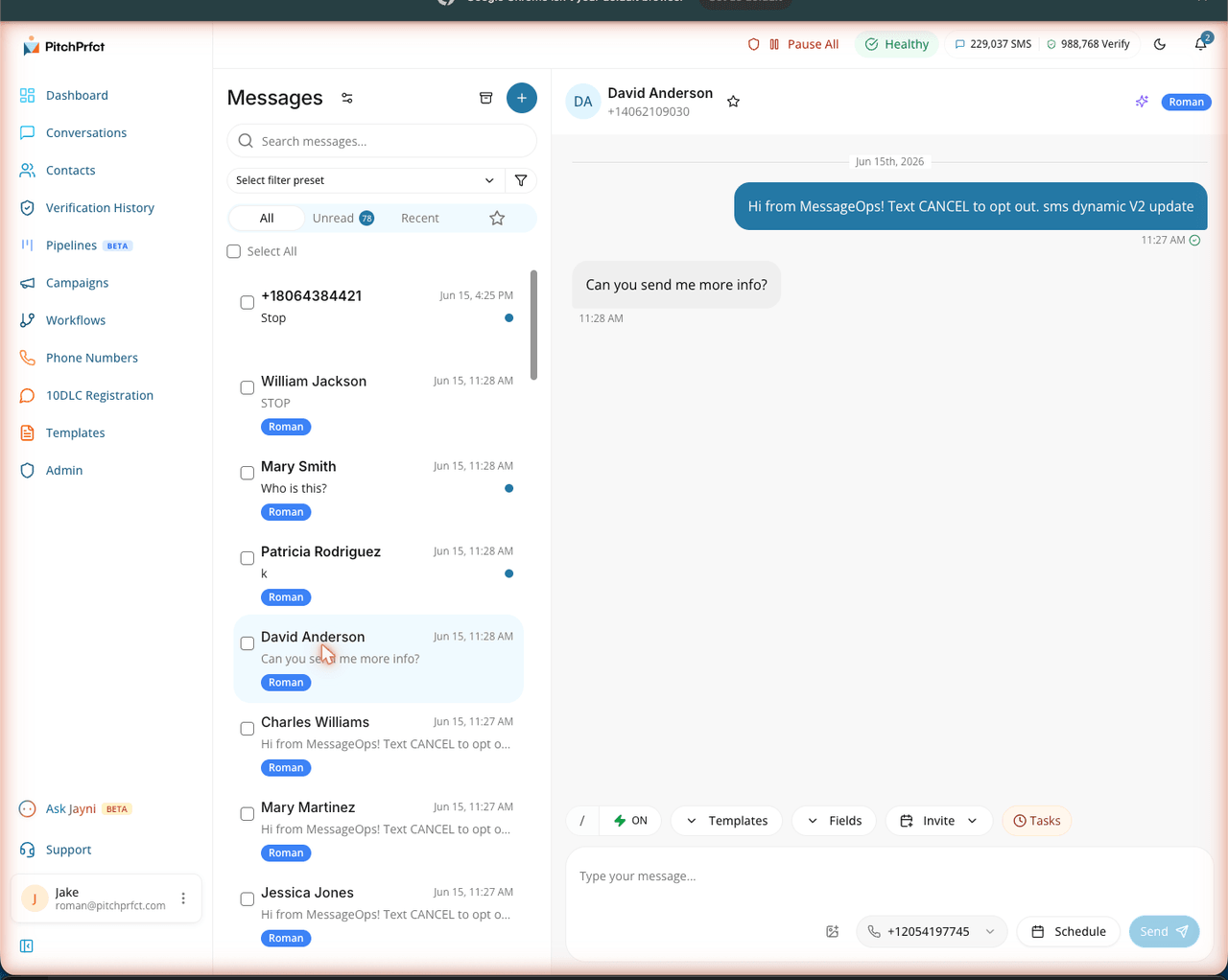
Replies land in one conversations inbox as separate 1:1 threads, so you answer each person without anyone else in the loop. Opt-outs are handled automatically: someone texts STOP, they're removed, and you stay clean. Guided 10DLC registration gets your business number approved and sending in days.
The pricing is all-in: $99/month after a 14-day free trial, $0.007 per SMS segment with carrier fees already included. Each number is $1/month and the standard $10/month TCR campaign fee applies. No credit buckets, no per-message surcharge — the per-text rate is the per-text rate.
See pricing → or start a free trial →.
Related reading
- SMS blast guide — how to send one message to a whole list, the right way.
- The best mass texting apps in 2026 — the tools that send broadcasts at scale, ranked.
- SMS vs MMS — the two message types and when each one fits.
- What is SMS marketing? — the full primer on texting customers at scale.
Frequently asked questions
What is a mass text?
Is a mass text the same as a group text?
How do I send a mass text without a group thread?
How many people can be in a group text?
Why not just group text my customers?
What is the difference between a group chat and a mass text?
Ready to send personalized broadcasts your customers actually want to read? Start a free trial.