
SMS is a plain-text message capped at 160 characters per segment. MMS carries media — a photo, GIF, audio clip, short video — and stretches the text limit to 1,600 characters. Same phone number, same inbox, two different message types. For business texting, the one you pick changes what you can say and what each send costs. Here's the full breakdown.
SMS vs MMS at a glance
| SMS | MMS | |
|---|---|---|
| Stands for | Short Message Service | Multimedia Messaging Service |
| Content | Text only | Text + images, GIFs, audio, short video |
| Text limit | 160 characters per segment | Up to 1,600 characters |
| Media | None (links only) | Photos, GIFs, audio, video, vCards |
| Internet needed | No | No (uses carrier data, not Wi-Fi) |
| Reach | Every mobile phone | Nearly every smartphone |
| Relative cost | Lowest | ~3x an SMS segment |
| PitchPrfct cost | 1 credit = $0.007 all-in | 3 credits ≈ $0.021 all-in |
| Best for | Alerts, reminders, links, OTPs | Coupons, product shots, flyers, branding |
Both ride the carrier network, so neither needs the recipient on Wi-Fi or running a specific app. That's the whole reason texting beats app-based messaging for reach: it lands on any phone, no install required.
What is SMS?
SMS stands for Short Message Service. It's the original text message, around since the early 1990s, and it carries plain text only. No images, no formatting, no buttons. You can paste a link, but the recipient sees the raw URL.
Every phone ever made handles SMS. No smartphone required, no app, no data plan. That universal reach is why carriers and businesses lean on it for the messages that absolutely have to arrive: appointment reminders, delivery alerts, one-time passcodes, a quick "you're approved."
The SMS character limit
A single SMS segment holds 160 characters. That number isn't arbitrary — it's the most text that fits in one 140-byte message using GSM-7, the standard encoding for Latin text. Stay under 160 and you send one segment.
Go over, and the message gets split. This is where billing surprises happen, so it's worth understanding.
How segmentation works
When your text runs past 160 characters, the carrier breaks it into multiple segments and the receiving phone stitches them back into one message. The recipient sees a single text. You get billed for every segment.
One detail trips people up: concatenated messages don't get 160 characters per segment. Each segment gives up a few characters to header data that tells the phone how to reassemble the pieces in order. So a long message counts at 153 characters per segment.
Emojis and special characters change the math again. The moment you drop in an emoji, an accented letter, or a non-Latin character, the message switches to Unicode encoding (UCS-2). That cuts a single message to 70 characters, and 67 per segment once it's concatenated.
| Message contents | Single segment | Per segment when long |
|---|---|---|
| Plain text (GSM-7) | 160 characters | 153 characters |
| Any emoji or special character (Unicode) | 70 characters | 67 characters |
So a 300-character plain-text message is 2 segments. The same message with one emoji jumps to 5 segments. One smiley face can more than double your cost. Worth knowing before you send to 5,000 people.
What is MMS?
MMS stands for Multimedia Messaging Service. It does everything SMS does and adds media: a product photo, an animated GIF, an audio clip, a short video, even a contact card. It also raises the text ceiling to 1,600 characters, so you can write a full paragraph without it splitting into segments.
MMS still travels over the carrier network like SMS. It uses cellular data to move the media, but the recipient doesn't need Wi-Fi or an app. Reach is nearly universal — almost every phone in use today is a smartphone that handles MMS.
The trade-offs are real. File sizes are capped (carriers generally allow around 300KB to 600KB, with video clips running about 40 seconds before they get compressed). And every MMS costs more than a plain text. For a flash-sale coupon graphic or a new-listing photo, the visual is worth it. For a one-line reminder, it's overkill.
Cost: SMS vs MMS
This is the part that actually moves your bill. MMS costs more than SMS, full stop. Across the industry an MMS typically runs about three times the price of a single SMS segment.
With PitchPrfct, the math is clean and the carrier passthrough fees are already baked in:
- SMS: 1 segment = 1 credit = $0.007, all-in.
- MMS: 3 credits ≈ $0.021, all-in.
That's on the per-message rate. The platform itself is $99/month after a 14-day free trial, each phone number is $1/month, and the standard $10/month TCR campaign fee applies. Inbound replies count as half a credit.
Here's where it gets interesting. A long plain-text SMS can quietly cost more than a single MMS. Picture a 500-character announcement: that's 4 SMS segments (4 credits, ~$0.028) versus one MMS that holds 1,600 characters for 3 credits (~$0.021). Once your copy runs long, sending it as a single MMS can be the cheaper option — and it arrives as one clean message instead of a multi-part text.
Key takeaways: SMS is text-only, 160 characters per segment, and the cheapest way to send. MMS adds media and up to 1,600 characters of text for about 3x the cost of one segment. Use SMS for short, fast, transactional messages. Use MMS when a picture or a longer message earns its keep. With PitchPrfct, an SMS segment is $0.007 all-in and an MMS is ~$0.021 all-in.
Reach and deliverability
Both SMS and MMS reach essentially every mobile phone in the US without an app or a login. That's their core advantage over iMessage, WhatsApp, or RCS, which depend on the right device, an internet connection, or both.
SMS has the slight edge on raw universality — it works on the oldest flip phone and the newest smartphone alike. MMS needs a device that can render media, which in 2026 is nearly all of them.
What matters more for deliverability than the message type is your sending setup. Business texting to US numbers runs through 10DLC registration, and your opt-in hygiene drives whether carriers trust your traffic. Get consent right and honor opt-outs, and both SMS and MMS land reliably. The FCC and the CTIA Messaging Principles set the ground rules; this isn't legal advice, but consent-first sending is the practical foundation.
When to use SMS vs MMS
The rule of thumb: SMS for utility, MMS for impact.
Reach for SMS when:
- The message is short and to the point — a reminder, a confirmation, a status update.
- Speed and cost matter more than visuals (alerts, OTPs, time-sensitive notices).
- A plain link does the job. "Your appointment is tomorrow at 2pm. Reply C to confirm."
- You're sending high volume and want the lowest per-message rate.
Reach for MMS when:
- A visual sells the message — a coupon graphic, a property photo, a menu, an event flyer.
- You want your brand to stand out in the thread. A logo or product shot reads as more legit than a wall of text.
- The copy is genuinely long and a multi-segment SMS would cost the same or more.
- You're running a promotion where the image is the offer.
A real-estate agent texting a new listing? MMS, with the front-of-house photo. A clinic confirming tomorrow's appointment? SMS. A restaurant blasting a weekend special? MMS with the dish photo. A lender nudging a borrower to finish an application? SMS with a link. Match the message type to the job.
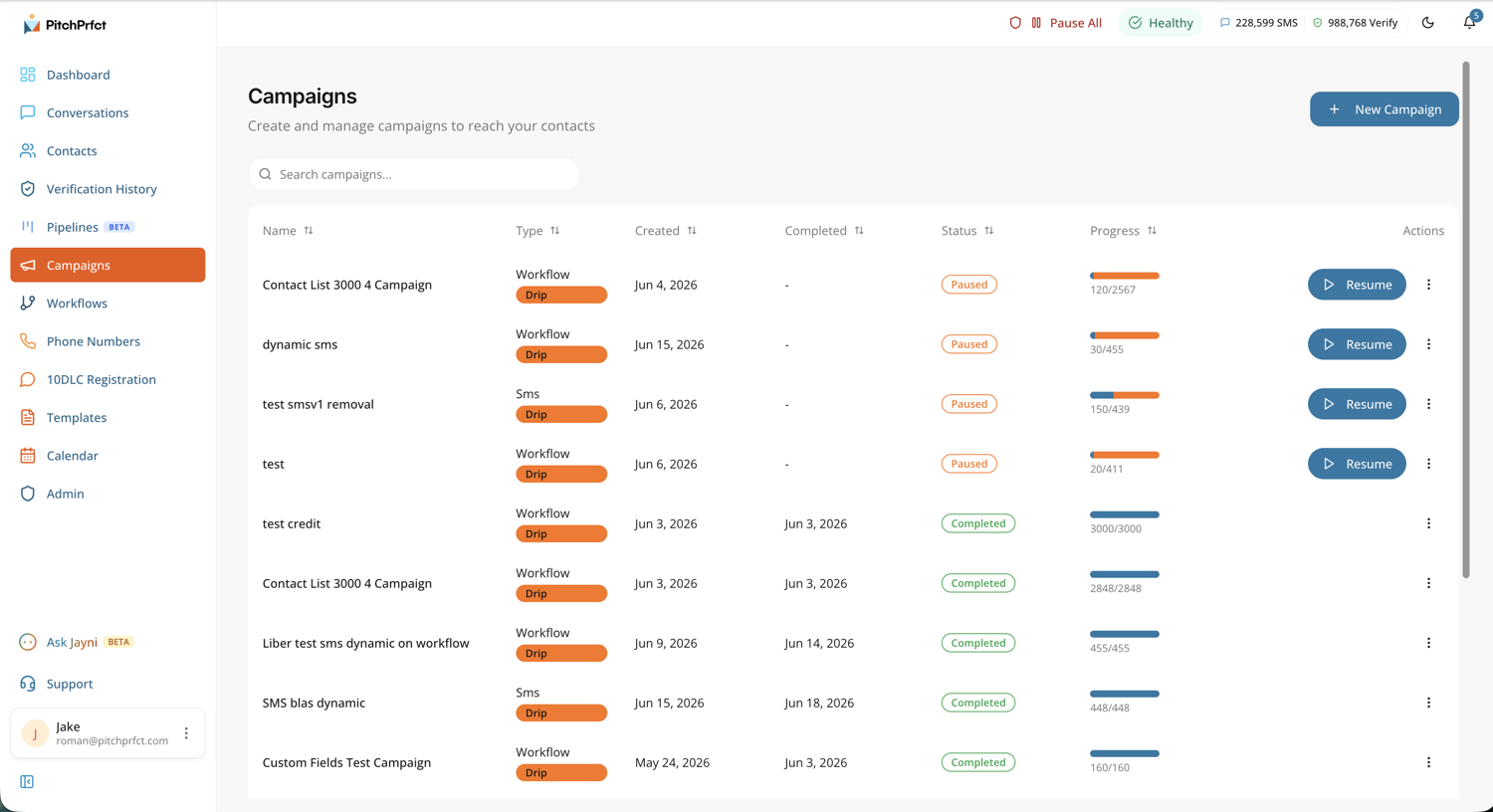
PitchPrfct supports both, in the same campaign builder and the same conversations inbox. You compose a campaign, attach an image to make it MMS or leave it as text for SMS, and the credit cost adjusts automatically.
SMS, MMS, and RCS
You'll see RCS (Rich Communication Services) mentioned alongside SMS and MMS. RCS is the newer carrier-backed standard that adds read receipts, typing indicators, and richer cards. It's growing, but it depends on device and carrier support, so it isn't yet the universal fallback that SMS and MMS are. For business texting that has to reach everyone, SMS and MMS remain the dependable pair. RCS is a layer on top, not a replacement.
Related reading
- What is SMS marketing? — the full primer on texting customers at scale.
- SMS blast guide — how to send one message to a whole list, the right way.
- SMS marketing examples — real copy you can adapt, across verticals.
- What is 10DLC? — the registration that keeps your business texts deliverable.
Frequently asked questions
What is the SMS character limit?
What is the difference between SMS and MMS?
What is MMS?
Is MMS more expensive than SMS?
When should I use MMS?
Do SMS and MMS need the internet?
Want to send SMS and MMS from one platform at the lowest all-in rates? Start a free trial.