
RCS messaging is the upgraded version of regular texting. The full name is Rich Communication Services, and it adds the things SMS never had: read receipts, typing indicators, high-resolution photos and video, and verified business profiles — all inside the same Messages app you already use. As of 2026 it runs on both Android and iPhone. Here's what RCS is, how it stacks up against SMS, and what it actually means if you text customers for a living.
What is RCS messaging?
RCS is a carrier-based messaging standard meant to replace SMS and MMS. SMS has stayed where it was in the 1990s — 160 characters, no receipts, low-res images. RCS brings texting up to what people expect from an app like WhatsApp or iMessage, without making anyone download anything. It lives in the phone's built-in messaging app.
On Android that's Google Messages. On iPhone it's the standard Messages app. The key point: RCS is a feature of the carrier and the default texting app, not a separate service you sign up for.
Apple describes RCS plainly. It's "a carrier-provided service" that lets you "send texts, high resolution photos and videos, links, and more," and it "supports delivery receipts, read receipts and typing indicators." (Apple Support, updated May 2026.)
What is an RCS message?
An RCS message is a text sent over the Rich Communication Services protocol instead of over old SMS/MMS. To the person reading it, it looks like a normal text — same thread, same app. The difference is what it can carry: a sharp photo instead of a compressed blur, a read receipt so the sender knows it landed, a "…" typing bubble, and, for businesses, things like product cards, buttons, and a verified sender name with a logo.
If RCS isn't available — the recipient's carrier doesn't support it, they're on an old phone, or they're offline — the message falls back to SMS automatically. The sender doesn't have to do anything; the system just downgrades to make sure the text gets through.
RCS vs SMS: the differences that matter
SMS and RCS both deliver texts, but they're built for different eras. SMS is universal and dead simple. RCS is richer and smarter, as long as the conditions line up. Here's the side-by-side.
| RCS | SMS | |
|---|---|---|
| Media | High-resolution photos, video, audio, files | Text only (MMS adds low-res media) |
| Message length | Long-form, no hard 160-char cap | 160 characters per segment |
| Read receipts & typing | Yes — delivery, read, and typing indicators | No |
| Business branding | Verified sender name, logo, color, cards (RBM) | Plain text from a number or short code |
| Encryption | End-to-end on supported setups (rolling out) | Not encrypted |
| Fallback | Drops to SMS when unavailable | Is the fallback |
| Reach / universality | Android + iPhone, but carrier-dependent | Every phone, every carrier, worldwide |
| Business availability | RBM still rolling out; access varies | Mature, available everywhere via 10DLC |
The honest summary: RCS is better technology, SMS is better coverage. A text sent over SMS reaches essentially any working phone on the planet. An RCS message only reaches people whose device, carrier, and app all support it. When one of those isn't true, it quietly becomes an SMS anyway.
Where RCS adoption stands in 2026
The big shift happened in 2024. Apple added RCS support to the iPhone in iOS 18, which means RCS now works for texting between Android phones and iPhones — not just Android to Android. Google confirms it directly: "RCS is now available for texting between Android and iPhones." (Google Messages Help.)
That sounds like RCS has arrived. Partly true. A few things keep it from being a clean replacement for SMS yet:
- It's carrier-provided. Apple notes RCS isn't supported by all carriers or in all countries, and activating it can take a few hours after setup (Apple Support, May 2026). No carrier support means no RCS.
- Encryption is still catching up. Cross-platform end-to-end encryption for RCS is rolling out in stages and depends on carrier and OS support, per Apple's documentation (as of mid-2026).
- Business RCS is the newest piece. The branded business side — called RCS Business Messaging, or RBM — is real but still maturing. Availability for senders varies by carrier and region.
So in 2026, RCS is genuinely live and growing, but it sits on top of a patchwork of carrier support. SMS is the floor everyone shares; RCS is the upgrade that kicks in when everything aligns.
RCS for business: the pros and the limits
For marketing and customer messaging, RCS Business Messaging is the headline. A verified business profile means your texts can show your brand name and logo instead of a random number, which builds trust. You can send richer content — image carousels, suggested-reply buttons, appointment cards. And you get delivery and read analytics that plain SMS can't give you.
That's the upside. The limits are the same ones that hold RCS back everywhere:
The good
- Branded, verified sender identity (name + logo, not a mystery number).
- Rich, interactive content — cards, carousels, quick-reply buttons.
- Read and delivery receipts for real engagement data.
The limits
- Reach is uneven. You can't count on every contact receiving RCS, so you need SMS fallback regardless.
- Onboarding for verified business sending is more involved and varies by carrier and region.
- It's newer, with fewer mature tools and less predictable deliverability than the SMS rails businesses have leaned on for years.
The practical pattern most businesses land on is a hybrid: use RCS where it's available for the richer experience, and rely on SMS as the universal layer that guarantees the message gets through.
What this means for business texting today
If you're choosing how to reach customers right now, here's the grounded read. SMS is still the workhorse. It reaches everyone, it's predictable, and the business framework around it — 10DLC registration, consent, opt-out handling — is mature and well understood. When you need a message to land, SMS lands.
RCS is worth watching and, where it's available, worth using for the richer experience. But it isn't a reason to wait on building your texting program. The fundamentals don't change: get consent, identify yourself, make opting out easy, and respect quiet hours. Those rules apply to SMS and RCS alike, and they're what keep your messages deliverable either way.
A note on where we fit: PitchPrfct is an SMS platform. We don't offer RCS — we focus on doing SMS well, at the lowest all-in rate, with compliance built in. We wrote this guide because customers ask what RCS is and whether they're missing out. The honest answer: for reaching every customer reliably today, SMS is still the right foundation, and that's the part we make easy.
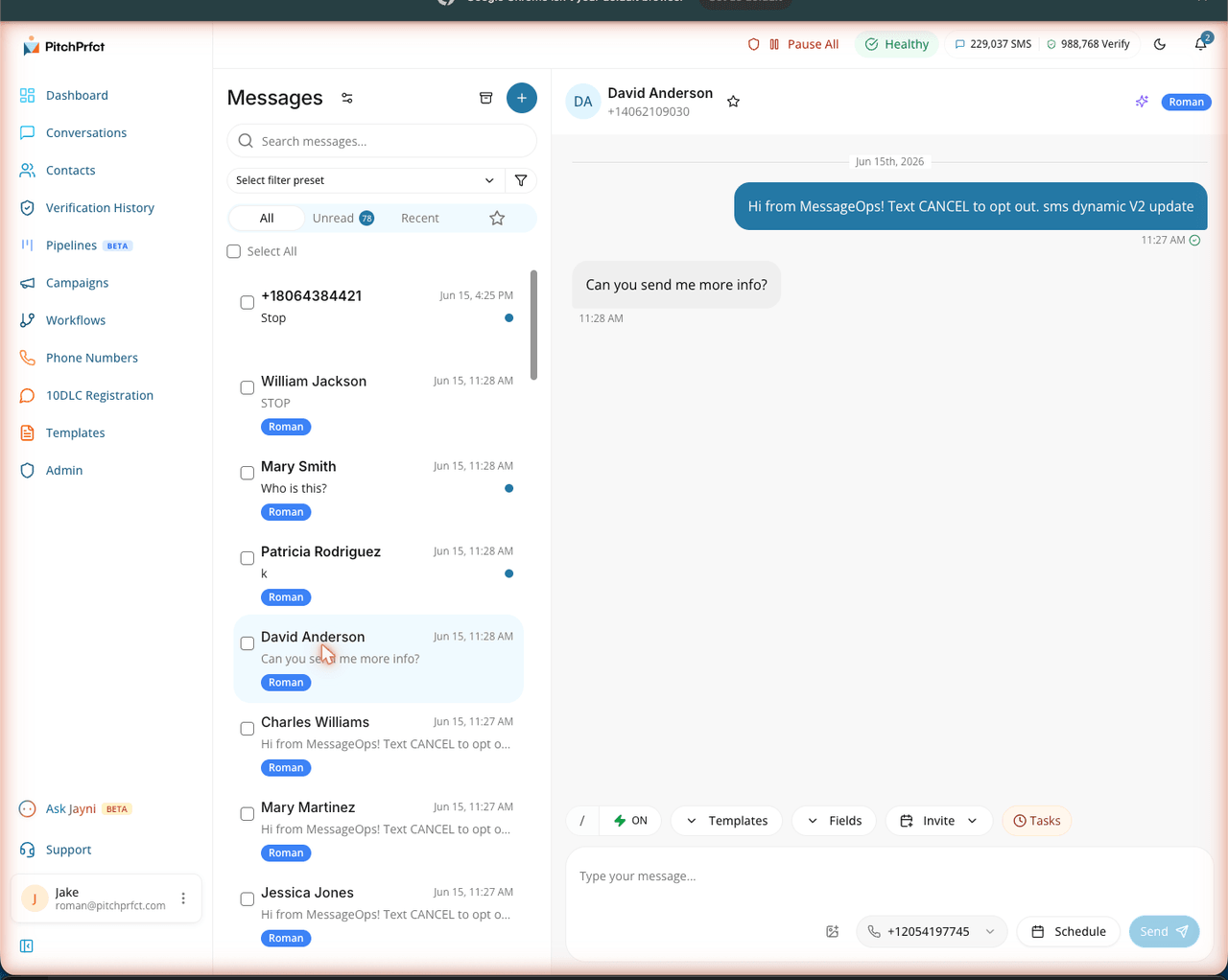
Here's the conversations side of an SMS platform in practice — every reply in one place, with delivery status on each message:
If you're newer to all of this, start with what SMS marketing is and the difference an SMS blast makes for reaching a list fast.
Frequently asked questions
What is an RCS message?
Is RCS better than SMS?
Does RCS work on iPhone?
What does RCS stand for?
Can businesses send RCS messages?
Do I need to turn on RCS?
Related reading
- What is SMS marketing? — the practical pillar on how business texting works, what it costs, and the rules that matter.
- What is an SMS blast? — how to reach a whole list at once, the right way.
- What is 10DLC? — the carrier registration that makes business SMS deliverable in the U.S.
Want reliable, compliant SMS that reaches every customer — at the lowest all-in rate? Start a free trial.